
Where to Put a Bird Cage: Room by Room, from the Avian Vets
Affiliate disclosure: product links on this page go to Amazon, or to the maker's own store for brands that sell only direct. As an Amazon Associate we earn from qualifying purchases, at no extra cost to you; a link to a maker's store earns us nothing. No retailer or brand sees our picks before they are published or has any say in them. How we choose.
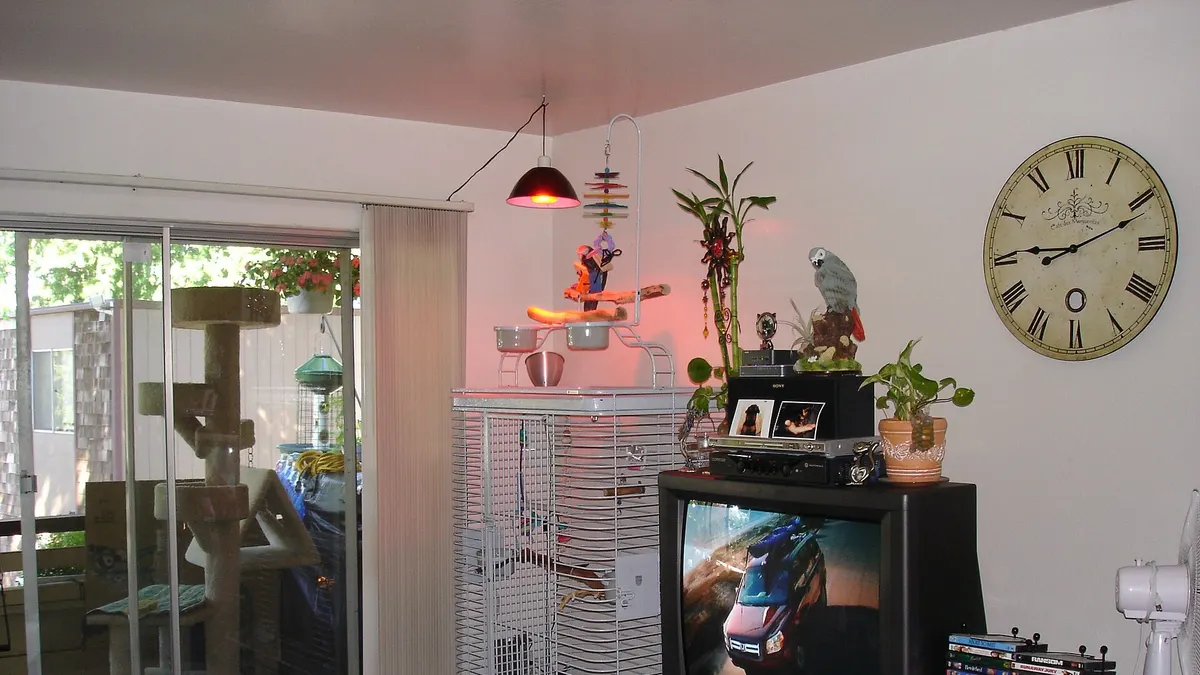
The right room is the one the family uses, and the wrong room is the one with the stove. PetMD's Dr. Patricia Latas: put the cage where family activity happens, against a wall so the bird has a safe side, about chest height, away from windows and drafts, not under an overhead lamp, not in the kitchen or garage, and move it if what goes on nearby stresses the bird. The Merck Veterinary Manual's owner page: away from windows, air conditioners and drafts, not the kitchen, at a comfortable room temperature. VCA Animal Hospitals: never the kitchen or the laundry room, because of non-stick fumes, and no bird out with a ceiling fan running. RSPCA Australia: out of the sight and sound of predators, not in the busiest traffic, protected from loud noise, with shelter from wind, rain and sun outdoors. This guide takes those rules room by room and then through the details: height, walls, windows, drafts, noise, other pets, night and the cover question, where Merck and PetMD disagree.
Room by room
| Room | Verdict | Why, and who says |
|---|---|---|
| Living or family room | Best | Where the family is (PetMD); social birds (RSPCA); a wall to back onto and a view of the room |
| Kitchen | Never | PTFE fumes from non-stick pans, drip pans and appliances can kill a bird, sometimes at ordinary temperatures (VCA); smoke and cooking fumes (VCA); Merck and PetMD both say not the kitchen; see the bird toxins database |
| Open-plan kitchen and living room | Only with no PTFE in the house | VCA: the only reliable prevention is not using PTFE around birds; a wall between does not stop fumes |
| Laundry room | Never | Irons, ironing-board covers and heating elements with PTFE (VCA); fumes and heat |
| Bedroom | Good for sleep, poor for company | Dark and quiet for 10 to 14 hours (PetMD); a bird alone all day in a bedroom is isolated; a second, sleep cage is PetMD's answer |
| Home office | Good | Company all day; keep it off the desk edge and away from the printer's warm exhaust; a screen is not an overhead lamp |
| Sunroom or by a window | With care | Merck and PetMD: away from windows and drafts; sun through glass overheats a bird that cannot move away and supplies no UVB (Merck's nutrition page: owners wrongly assume glass-filtered sunlight gives UVB) |
| Garage, basement, hallway | No | PetMD: not the garage; fumes, cold, isolation, traffic |
| Bathroom | No | Open water (VCA), aerosols, humidity swings, isolation |
| Outdoors | Supervised, or in a proper aviary | RSPCA: shelter from wind, rain and sun, away from predators; the outdoor aviary guide covers wire and weather |
Height
Dr. Latas puts the cage at about chest height. The practical version: the top perch at or a little below your eye level, so you look at the bird rather than down on it and it is not looking up at everything. A cage on the floor is at dog and toddler height; a cage above head height is a bird nobody interacts with. A stand with casters (most of the cages in our conure and grey guides have one) lets the cage move to the family in the day and to the quiet at night.
Walls and corners
One side against a wall (PetMD) gives the bird a side nothing approaches from; two, in a corner, gives a shy bird two. A cage in the middle of a room is approached from everywhere, and Dr. Latas says a bird under constant observation is stressed. The corner cages in the grey guide exist for this.
Windows, sun and drafts
Merck and PetMD both say away from windows and drafts. Sun through glass warms the cage and the bird cannot leave it; a window is also what hawks and cats are seen through (RSPCA: out of the sight of predators). Drafts come from windows, air conditioners (Merck), heating vents and doors; a candle flame held at the cage shows them. Glass supplies no UVB, so the window is not a substitute for the lighting question.
Noise and traffic
RSPCA: not in the busiest part of the house, protected from loud noise. PetMD: where the family is, and moved if the activity is stressful. The two agree more than they seem to: beside the sofa, not beside the front door or the television's speaker. A bird that sits fluffed or screams when a particular thing happens nearby is telling you where not to put the cage.
Other pets
VCA: never leave cats, dogs, ferrets, snakes or lizards alone with a bird; a cat scratch is an emergency. The cage goes where a cat cannot sit on top of it or reach a paw through, which usually means not beside a bookcase or a sofa back. RSPCA: out of the sight and sound of predators, which includes the house cat looking at it all day.
Fans, fumes and the things above
Ceiling fans off whenever the bird is out (VCA). No candles, aerosols, smoke or scented products in the bird's room (VCA). Not under a stucco or popcorn ceiling the bird can reach from the cage top (VCA), and not under the overhead light a bird perceives as a threat from above (PetMD).
Night
Ten to twelve hours of sleep, twelve to fourteen for some birds, in a dark, quiet room (PetMD). If the cage lives in the living room and the living room is lit until midnight, the bird is not sleeping; the answers are a sleep cage in a dark room (PetMD's two-cage suggestion) or a cover. On covers the sources split: Merck's owner page says most birds should not be covered at night; PetMD says cover the cage or put it in a dark room. Both want dark and quiet. Our reading: in a dark, quiet bedroom a cover adds nothing; in a bright, late room it is the tool that makes the night dark, and Prevue's breathable covers in the supplies guide are made for that. A cover is never a reason to leave a bird in a noisy room.
Temperature
Merck: a comfortable room temperature, out of drafts. VCA's hazards page: never in a car in heat, and heat lamps are a PTFE source. A bird's room is heated and cooled like a person's; the cage is not placed beside the radiator, the vent or the air conditioner.
The one-sentence answer
Against a wall in the room the family uses, at chest height, out of the sun and the draft, nowhere a cat can reach, in a house where nothing non-stick is heated, with a dark, quiet place for the night. The safety checklist has the rest of the room; the setup guide has the cage.
Frequently asked questions
Can I keep a bird cage in the kitchen?
No. VCA says never to house a bird in the kitchen or laundry room because fumes from heated non-stick (PTFE) cookware and appliances can kill birds, and Merck and PetMD both say not the kitchen. An open-plan kitchen is only workable if nothing non-stick is used in the house.
Should a bird cage be in the bedroom?
It gives the dark, quiet 10 to 14 hours of sleep PetMD describes, but a bird alone in a bedroom all day is isolated. PetMD's answer is two cages: a day cage where the family is and a sleep cage in a dark room.
Can a bird cage go in front of a window?
Merck and PetMD say away from windows and drafts: sun through glass overheats a bird that cannot move, predators are seen through it (RSPCA), and glass supplies no UVB (Merck). Across the room from a window, with the light but not the glass, is the usual compromise.
How high should a bird cage be?
About chest height (PetMD), with the top perch at or a little below your eye level. Not on the floor, not above head height.
Should I cover my bird's cage at night?
The sources split: Merck's owner page says most birds should not be covered, PetMD says cover or darken the room. Both want 10 to 14 hours of dark and quiet. In a dark bedroom a cover adds nothing; in a lit living room it makes the night dark.
Can my bird's cage be near the cat or dog?
VCA says never to leave cats, dogs, ferrets, snakes or lizards alone with a bird, and RSPCA says keep birds out of the sight and sound of predators. Put the cage where a cat cannot sit on it or reach through, and supervise all out-of-cage time.
Sources
- How to Set Up the Perfect Bird Cage, PetMD (Dr. Patricia Latas, DVM)
- Providing a Home for a Pet Bird, Merck Veterinary Manual
- Household Hazards and Dangers to Birds, VCA Animal Hospitals
- Teflon Toxicity (PTFE Poisoning) in Birds, VCA Animal Hospitals
- How to help your pet bird have a good life, RSPCA Australia
- Nutrition in Psittacines (vitamin D and UVB), Merck Veterinary Manual
Cover photo: Living room -pet parrot -cage-8a by Diana, CC BY 2.0, via Wikimedia Commons. Cropped.
Related guides
Bird Cage Bar Spacing Guide: The Right Gap for Every Species, and Why
The Merck bar-spacing figures by species, the finger test, why gauge matters as much as gap for big birds, and cages that match each figure.
Bird Cage Buying Guide: Size, Spacing, Material, Doors, Tray and Price, in Order
The checks in order before buying any cage: species minimum, spacing and gauge, material, shape, doors, tray, stand, the listing's traps and the price by size class.
Bird Cage Cleaning and Disinfecting Guide: Daily, Weekly and the Full Sequence
The daily routine from VCA and PetMD, the CDFA's six-step deep clean with label-only disinfecting, and the products and fumes to keep out of a bird room.