
Best Full-Spectrum and UVB Bird Lights (2026): What the Vets Say, Then the Lamps
Affiliate disclosure: product links on this page go to Amazon, or to the maker's own store for brands that sell only direct. As an Amazon Associate we earn from qualifying purchases, at no extra cost to you; a link to a maker's store earns us nothing. No retailer or brand sees our picks before they are published or has any say in them. How we choose.
Start with what the avian sources say, because the lamp listings say a great deal more. The Merck Veterinary Manual's nutrition page (reviewed September 2025): UVB light at 285 to 315 nm converts a precursor in the skin to vitamin D3; deficiency can come from diet or from lack of UVB; how much vitamin D parrots get in the wild from food or sun is unknown; species vary in their UVB needs; many pet birds live entirely indoors, and owners wrongly assume sunlight through glass supplies UVB (it does not); Merck's advice is UVB bulbs or direct sunlight with care about heat, noting that the farther from the equator, the less UVB there is in late autumn, winter and early spring. The Association of Avian Veterinarians' enrichment post (September 2022): most windows filter out UVB; in warm months take the bird outside, supervised, for at least 20 to 30 minutes two or three times a week; in winter use UVB lighting near the cage; how long and how far depends on the bulb; give the bird a UV gradient so it can move away; ask your avian veterinarian, and ask for the AAV's handout on ultraviolet lighting for companion birds. Lafeber's veterinary Q&A (2021): there have been no formal studies, the vets' advice varies, the common advice has been full-spectrum lighting on a timer for up to four hours a day from above and not too close, with maker-specified low-dose bird lamps run up to 12 hours by their makers' directions; full-spectrum light is secondary, part-time and optional, and a healthy parrot on a balanced diet in a good environment is unlikely to be deficient. Nothing on this page adds a health claim to those. What we can judge is the lamp: stated UVB output, the fixture, the maker's distance and replacement instructions, and the price. The Zoo Med AvianSun Deluxe floor lamp with bulb ($95) is the pick because Zoo Med publishes a manual with distances and a burn-in; the Arcadia PureSun Compact kit ($80, 2.4% UVB, 30% UVA, 20 W) is the one with a stated UVA figure and a guard; the Oiibo hood and bulb kit ($47) is the budget fixture; the REPTI HOME ($18) and Sundew ($17) are replacement 2.4% UVB bulbs; the HappyBird LED ($105) is the full-spectrum LED with no UV, for owners who want daylight colour and a photoperiod and no UVB question at all.
Our top picks at a glance
1. Best overall
Zoo Med AvianSun Deluxe Floor Lamp AFL-11 with AvianSun 5.0 UVB bulbStated output: AvianSun 5.0 UVB compact fluorescent, included (Zoo Med); 5.0 is Zoo Med's product designation, not a percentage it states on the listing · Fixture: Adjustable gooseneck floor lamp with built-in reflector, 3.4 x 11.5 x 22.5 in (per the Amazon listing) · Maker's distance and life: Zoo Med's manual: 18 to 20 in from the bird during a two-week burn-in, 12 to 14 in after; directly overhead, not from the side; replace at 12 months and date the base
2. Best stated output
Arcadia PureSun Compact Bird Lighting Kit, 20 W, 2.4% UVBStated output: 2.4% UVB, 30% UVA, 20 W, daylight white (per the Amazon listing) · Fixture: Compact reflector hood, E26/E27 holder, bracket, safety grill (per the Amazon listing) · Maker's distance and life: Effective UV emission typically up to 1 year (per the Amazon listing); no distance stated in the listing
3. Best fixture under $50
Oiibo Bird Cage Light Fixture Kit with 2.4% UVB 20 W BulbStated output: 2.4% UVB and UVA, 20 W compact fluorescent, E26 (per the Amazon listing) · Fixture: Reflector hood, bolt-through cage lamp holder, clip-on safety grill, independent switch, built-in ballast (per the Amazon listing) · Maker's distance and life: Not stated in the listing; 12-month support (per the Amazon listing)
4. Best replacement bulb with a distance
Sundew 2.4% UVB Bird Light Bulb, 20 W E26Stated output: 2.4% UVB, UVA, CRI 85.6, 20 W, E26 (per the Amazon listing) · Fixture: Bulb only; fits E26 sockets and dome fixtures (per the Amazon listing) · Maker's distance and life: 12 to 18 in above the bird's highest perch; replace every 6 to 12 months as UV output degrades (per the Amazon listing)
5. Best budget replacement bulb
REPTI HOME 2.4% UVB Compact Fluorescent Bulb for Birds, 20 W E26Stated output: 2.4% UVB, UVA, 20 W, 120 V, E26; no UVC (per the Amazon listing) · Fixture: Bulb only (per the Amazon listing) · Maker's distance and life: Not stated; the listing says use a good-quality holder, no dimmers, thermostats or rheostats, no water on the bulb
6. Best no-UV option
HappyBird Full Spectrum LED Bird Cage Light with Chew Guard (no UVB)Stated output: Full-spectrum LED, no UVB (per the Amazon listing) · Fixture: LED bar with chew guard, mounting brackets, stainless wire ties, power supply; water-resistant (per the Amazon listing) · Maker's distance and life: Mounts inside or on top of the cage; no bulbs to replace (per the Amazon listing)
| Pick | Stated output | Fixture | Maker's distance and life | Buy |
|---|---|---|---|---|
| Zoo Med AvianSun Deluxe Floor Lamp AFL-11 with AvianSun 5.0 UVB bulbBest overall | AvianSun 5.0 UVB compact fluorescent, included (Zoo Med); 5.0 is Zoo Med's product designation, not a percentage it states on the listing | Adjustable gooseneck floor lamp with built-in reflector, 3.4 x 11.5 x 22.5 in (per the Amazon listing) | Zoo Med's manual: 18 to 20 in from the bird during a two-week burn-in, 12 to 14 in after; directly overhead, not from the side; replace at 12 months and date the base | Amazon |
| Arcadia PureSun Compact Bird Lighting Kit, 20 W, 2.4% UVBBest stated output | 2.4% UVB, 30% UVA, 20 W, daylight white (per the Amazon listing) | Compact reflector hood, E26/E27 holder, bracket, safety grill (per the Amazon listing) | Effective UV emission typically up to 1 year (per the Amazon listing); no distance stated in the listing | Amazon |
| Oiibo Bird Cage Light Fixture Kit with 2.4% UVB 20 W BulbBest fixture under $50 | 2.4% UVB and UVA, 20 W compact fluorescent, E26 (per the Amazon listing) | Reflector hood, bolt-through cage lamp holder, clip-on safety grill, independent switch, built-in ballast (per the Amazon listing) | Not stated in the listing; 12-month support (per the Amazon listing) | Amazon |
| Sundew 2.4% UVB Bird Light Bulb, 20 W E26Best replacement bulb with a distance | 2.4% UVB, UVA, CRI 85.6, 20 W, E26 (per the Amazon listing) | Bulb only; fits E26 sockets and dome fixtures (per the Amazon listing) | 12 to 18 in above the bird's highest perch; replace every 6 to 12 months as UV output degrades (per the Amazon listing) | Amazon |
| REPTI HOME 2.4% UVB Compact Fluorescent Bulb for Birds, 20 W E26Best budget replacement bulb | 2.4% UVB, UVA, 20 W, 120 V, E26; no UVC (per the Amazon listing) | Bulb only (per the Amazon listing) | Not stated; the listing says use a good-quality holder, no dimmers, thermostats or rheostats, no water on the bulb | Amazon |
| HappyBird Full Spectrum LED Bird Cage Light with Chew Guard (no UVB)Best no-UV option | Full-spectrum LED, no UVB (per the Amazon listing) | LED bar with chew guard, mounting brackets, stainless wire ties, power supply; water-resistant (per the Amazon listing) | Mounts inside or on top of the cage; no bulbs to replace (per the Amazon listing) | Amazon |
Best overall
Zoo Med AvianSun Deluxe Floor Lamp AFL-11 with AvianSun 5.0 UVB bulb
Zoo Med's gooseneck floor lamp with reflector and the AvianSun 5.0 compact fluorescent bulb, $95, backed by a manual that states distance, burn-in and replacement.
- Stated output
- AvianSun 5.0 UVB compact fluorescent, included (Zoo Med); 5.0 is Zoo Med's product designation, not a percentage it states on the listing
- Fixture
- Adjustable gooseneck floor lamp with built-in reflector, 3.4 x 11.5 x 22.5 in (per the Amazon listing)
- Maker's distance and life
- Zoo Med's manual: 18 to 20 in from the bird during a two-week burn-in, 12 to 14 in after; directly overhead, not from the side; replace at 12 months and date the base
- Birds
- Zoo Med markets it for all companion birds; the AAV's gradient rule applies (a shaded end of the cage)
Pros
- A written manual with distances, which no other lamp here has
- Floor stand, so nothing clamps to the bars for a beak to chew
- Bulb replacement is a standard E26 compact fluorescent, $16 to $18
Cons
- UVB percentage not stated on the listing
- Compact fluorescents lose UV output over the year, which is why the 12-month rule exists
- A gooseneck can be knocked; the lamp sits outside the cage, not on it
Zoo Med's Deluxe floor lamp (AFL-11) is listed as an adjustable gooseneck stand with a built-in reflector and the AvianSun 5.0 compact fluorescent bulb included. Zoo Med's manual for the bulb is what makes it the pick: run it 18 to 20 inches from the bird for about two weeks of burn-in, then 12 to 14 inches, directly overhead because birds take UV from above, with shade the bird can move to; replace the bulb at twelve months and write the date on the base. That is the AAV's "depends on the bulb" answered by the bulb's maker. The listing's bullet about UVB for growth, bones and egg production is Zoo Med's claim; Merck's page says UVB converts the vitamin D precursor and that species needs vary, and Lafeber's vets say the studies have not been done. The fixture without the bulb is $66 for owners who already have a bulb.
Best stated output
Arcadia PureSun Compact Bird Lighting Kit, 20 W, 2.4% UVB
Arcadia's complete kit: fixture, reflector, PureSun Compact 20 W bulb at 2.4% UVB and 30% UVA, bracket and safety grill, $80, with a one-year replacement interval.
- Stated output
- 2.4% UVB, 30% UVA, 20 W, daylight white (per the Amazon listing)
- Fixture
- Compact reflector hood, E26/E27 holder, bracket, safety grill (per the Amazon listing)
- Maker's distance and life
- Effective UV emission typically up to 1 year (per the Amazon listing); no distance stated in the listing
- Birds
- Indoor birds in cages and aviaries (per the Amazon listing); only 6 in stock when read
Pros
- States both UVB and UVA percentages
- Grill between bulb and bird
- Fits most cage tops by bracket
Cons
- No distance in the listing; ask Arcadia
- Lafeber's reptile lighting note: mesh guards can block a third of UVB, which applies to any grill and screen between bulb and bird
- Low stock
Arcadia's PureSun Compact kit is listed as a complete bird lighting kit: fixture, reflector, a 20 W PureSun Compact lamp at 2.4% UVB and 30% UVA, holder, bracket and safety grill, with consistent output typically up to a year. The stated percentages are the reason to pick it over an unbranded bulb; the listing's lines about enhancing feeding, breeding and wellbeing are Arcadia's. One caution from Lafeber's veterinary lighting material (written for reptiles): guards and screens between a UVB lamp and the animal block a substantial share of the UVB, so a grill and a cage top together put the bulb's output figure well above what reaches the perch, and the AAV's "ask your avian vet" is the answer to how far.
Best fixture under $50
Oiibo Bird Cage Light Fixture Kit with 2.4% UVB 20 W Bulb
A reflector hood with a bolt-through cage holder, a clip-on grill, a switch and a 20 W 2.4% UVB bulb, $47.
- Stated output
- 2.4% UVB and UVA, 20 W compact fluorescent, E26 (per the Amazon listing)
- Fixture
- Reflector hood, bolt-through cage lamp holder, clip-on safety grill, independent switch, built-in ballast (per the Amazon listing)
- Maker's distance and life
- Not stated in the listing; 12-month support (per the Amazon listing)
- Birds
- Small and medium wire cages: budgies, cockatiels, canaries, small doves (per the Amazon listing)
Pros
- Bolts to the cage top, so it stays where it is aimed
- Grill
- $47 with the bulb
Cons
- No distance or replacement interval stated
- Mounted on the cage, the bulb is within reach of a parrot that climbs the top: for small birds only, as the listing says
- The listing's bone-disease claims are the seller's
Oiibo's kit is listed as a reflector hood with a bolt-through holder that locks to the cage, a clip-on grill, a one-touch switch and a 2.4% UVB 20 W bulb, for small and medium wire cages. It is the cheapest complete fixture we read; it states no distance, so Zoo Med's 12 to 14 inches is the only published figure to borrow, and a cage-top mount puts the bulb at whatever height the cage is, which for a 40-inch flight cage is about right over the top perch and for an 18-inch cage is too close.
Best replacement bulb with a distance
Sundew 2.4% UVB Bird Light Bulb, 20 W E26
A 20 W E26 2.4% UVB compact fluorescent whose listing states 12 to 18 inches above the highest perch and replacement every 6 to 12 months, $17.
- Stated output
- 2.4% UVB, UVA, CRI 85.6, 20 W, E26 (per the Amazon listing)
- Fixture
- Bulb only; fits E26 sockets and dome fixtures (per the Amazon listing)
- Maker's distance and life
- 12 to 18 in above the bird's highest perch; replace every 6 to 12 months as UV output degrades (per the Amazon listing)
- Birds
- Parrots, greys, cockatiels, conures, budgies, canaries (per the Amazon listing)
Pros
- States a distance and a replacement interval
- Fits the Zoo Med and Oiibo fixtures
- $17
Cons
- Unverified brand; the figures are the listing's
- The feather-plucking and anxiety claims in the listing are the seller's
- Six-month replacement at the short end doubles the yearly cost
Sundew's bulb is listed as a 20 W, 2.4% UVB, E26 compact fluorescent with a CRI of 85.6, to be positioned 12 to 18 inches above the bird's highest perch and replaced every 6 to 12 months because UV output degrades. Those two instructions are more than most bulbs give. The listing also claims the bulb reduces feather plucking, boredom and anxiety; no source we read supports that, and we do not repeat it as ours.
Best budget replacement bulb
REPTI HOME 2.4% UVB Compact Fluorescent Bulb for Birds, 20 W E26
REPTI HOME's 20 W 2.4% UVB E26 compact fluorescent for birds, with its own safety instructions on holders, dimmers and water, $18.
- Stated output
- 2.4% UVB, UVA, 20 W, 120 V, E26; no UVC (per the Amazon listing)
- Fixture
- Bulb only (per the Amazon listing)
- Maker's distance and life
- Not stated; the listing says use a good-quality holder, no dimmers, thermostats or rheostats, no water on the bulb
- Birds
- All captive birds (per the Amazon listing)
Pros
- States no UVC output
- Safety instructions in the listing
- $18
Cons
- No distance or interval stated
- Reptile-brand bulb sold for birds; the output figure is the same 2.4% as the bird-branded ones
- The bone-disease claims are the seller's
REPTI HOME's bulb is listed as a 2.4% UVB, 20 W, 120 V E26 compact fluorescent for captive birds, with no UVC, stable output and a low fade rate, and with instructions to use a good lamp holder, avoid unstable voltage, never use it with dimmers, thermostats or rheostats and keep water off it. It is a reptile-brand bulb at the bird-lamp output figure; follow Zoo Med's distances for want of its own.
Best no-UV option
HappyBird Full Spectrum LED Bird Cage Light with Chew Guard (no UVB)
HappyBird's full-spectrum LED cage light with a chew guard, water-resistant housing and no bulbs to replace, which by its own listing emits no UV, $105.
- Stated output
- Full-spectrum LED, no UVB (per the Amazon listing)
- Fixture
- LED bar with chew guard, mounting brackets, stainless wire ties, power supply; water-resistant (per the Amazon listing)
- Maker's distance and life
- Mounts inside or on top of the cage; no bulbs to replace (per the Amazon listing)
- Birds
- Marketed for soft-billed birds such as finches and canaries as well as parrots (per the Amazon listing)
Pros
- No UV, so none of the distance and replacement questions
- Chew guard and stainless ties, built to be inside a cage
- Sets a daylight photoperiod on a timer
Cons
- Does nothing for vitamin D by Merck's account, since it has no UVB
- $105
- The listing's claim that UVB lamps cause cataracts in birds is the seller's; we found no veterinary source for it
HappyBird's cage light is listed as a full-spectrum LED with a chew guard, water-resistant housing, mounting hardware and stainless wire ties, no bulbs to replace, designed to simulate a natural photoperiod, and explicitly without UVB. It is the lamp for an owner who wants bright daylight-colour light on a timer and has decided, with their vet, against UVB; Merck's page says UVB is what converts the vitamin D precursor, so this is a light, not a UVB source, and the listing says so. Its claim that UVB lamps damage birds' eyes is HappyBird's; we found no avian veterinary source that states it and no source that refutes it, so it stays the seller's claim.
How we chose
Stated UVB and UVA output, whether the maker publishes a distance, a burn-in and a replacement interval, the fixture (floor stand, cage-top bolt or bulb only), a guard, and price (October 9, 2026). No lamp was judged on any claim about bone disease, plucking, mood or breeding, because the veterinary sources do not make those claims and we do not either.
What the sources say, in one table
| Point | Source |
|---|---|
| UVB at 285 to 315 nm converts a skin precursor to vitamin D3; deficiency can come from diet or lack of UVB | Merck, Nutrition in Psittacines (Sept 2025) |
| How much vitamin D parrots get from food or sun in nature is unknown; species vary in UVB needs | Merck |
| Sunlight through glass does not supply UVB; UVB bulbs or direct sun with heat precautions; less UVB far from the equator in late autumn, winter, early spring | Merck |
| Most windows filter UVB; 20 to 30 minutes outside, supervised, 2 to 3 times a week in warm months; UVB lighting near the cage in winter | AAV enrichment post (Sept 2022) |
| Exposure time and distance depend on the bulb; provide a UV gradient; ask your avian vet and for the AAV handout | AAV |
| No formal studies; vets' advice varies; common advice up to 4 h a day on a timer, from above, not too close; makers' low-dose bird lamps up to 12 h by their directions; secondary, part-time, optional | Lafeber veterinary Q&A (June 2021) |
| Outdoor-housed Hispaniolan Amazons had significantly higher calcifediol than indoor ones; no lamp was tested | West et al., J Avian Med Surg 2019;33(3):235-244 |
| Guards and screens block a substantial share of UVB; UVB LEDs untested for vitamin D synthesis (written for reptiles) | Lafeber veterinary lighting material (Baines) |
| Photoperiod affects the molt | Merck, Management of Pet Birds |
Reading a lamp listing
"2.4% UVB" is the share of the lamp's output in the UVB band, and every bird-marketed compact fluorescent we read states the same 2.4%; it says nothing about how much reaches a perch 14 inches away through a grill. "5.0" on Zoo Med's bulb is a product name. "Full spectrum" alone means visible light and sometimes UVA (Lafeber's lighting material warns that lamps sold as bird or plant lamps may have no UVB at all); HappyBird's LED says so honestly. Lafeber's reptile guidance is to measure with a UV index meter rather than guess; no bird lamp here ships with one.
Distance, hours and the gradient
The only published distances we found are makers': Zoo Med's 18 to 20 inches during burn-in and 12 to 14 after, overhead; Sundew's 12 to 18 inches above the highest perch. Hours: Lafeber's vets report up to four on a timer as the common advice and up to twelve for lamps whose makers say so, and Lafeber's own answer is to follow the maker and stay conservative. The AAV's gradient means the lamp covers one end of the cage and the bird can sit at the other; a lamp that floods the whole cage removes the bird's choice. Compact fluorescents lose UV output over months, which is why Zoo Med and Sundew both give replacement intervals and why the base gets a date.
The outdoor alternative
The AAV's first suggestion is not a lamp: 20 to 30 minutes outside, supervised, two or three times a week in warm weather, which is also what the 2019 Amazon study measured. A carrier on a shaded patio (the carrier guide) or a wheeled aviary (the outdoor aviary guide) is the equipment; a hawk, a cat and heat are the risks VCA and the RSPCA name. In a northern winter Merck says the sun is weak anyway, which is where the lamp comes in.
What to skip
Skip buying a lamp on a health claim; buy it on the sources above and your vet's advice. Skip any bulb with no stated output. Skip mounting a bulb inside a parrot's reach. Skip dimmers on compact fluorescents (REPTI HOME's listing says so). And skip assuming the window is doing the job: Merck and the AAV both say glass does not.
Frequently asked questions
Do pet birds need a UVB light?
Merck says UVB converts the vitamin D precursor and that indoor birds without sun may lack it, and recommends UVB bulbs or direct sun; the AAV says use UVB lighting near the cage in winter and take the bird outside in summer; Lafeber's vets say there are no formal studies, advice varies, and a healthy parrot on a good diet is unlikely to be deficient. Ask your avian vet for your bird.
How far should a UVB lamp be from a bird?
The AAV says it depends on the bulb. Zoo Med's manual: 18 to 20 inches during a two-week burn-in, then 12 to 14 inches, directly overhead. Sundew's listing: 12 to 18 inches above the highest perch. Give the bird a shaded end to move to.
How many hours a day should a bird light be on?
Lafeber's vets report the common advice as up to four hours a day on a timer, from above, with maker-specified low-dose bird lamps run up to 12 hours per their directions, and advise following the maker and staying conservative. No formal study sets a number.
Does sunlight through a window give my bird UVB?
No. Merck says owners wrongly assume glass-filtered sunlight supplies UVB, and the AAV says most windows filter it out. The AAV suggests 20 to 30 supervised minutes outside two or three times a week in warm months.
How often should a UVB bulb be replaced?
Zoo Med says 12 months; Sundew says 6 to 12; Arcadia says effective emission typically up to a year. Compact fluorescents lose UV output before they stop lighting, so date the base.
Is a full-spectrum LED the same as a UVB lamp?
No. HappyBird's LED states it has no UVB; it gives daylight colour and a photoperiod. Lafeber's lighting material says lamps sold as bird or plant lights may emit only visible light and some UVA, and that UVB LEDs are untested for vitamin D synthesis.
Sources
- Nutrition in Psittacines (vitamin D and UVB), Merck Veterinary Manual
- UVB Enrichment (AAV Enrichment Tips, Liz Smith, September 6, 2022), Association of Avian Veterinarians
- Full spectrum lighting (veterinary Q&A, June 25, 2021), Lafeber Company
- UVB Lighting for Reptiles (Baines), LafeberVet
- West JA, Tully TN, Nevarez JG, Stout RW. Comparison of plasma 25-hydroxyvitamin D and ionized calcium in indoor- and outdoor-housed Hispaniolan Amazon parrots. J Avian Med Surg 2019;33(3):235-244, Journal of Avian Medicine and Surgery (PubMed)
- AvianSun 5.0 UVB compact fluorescent lamp instructions, Zoo Med Laboratories
- Management of Pet Birds, Merck Veterinary Manual
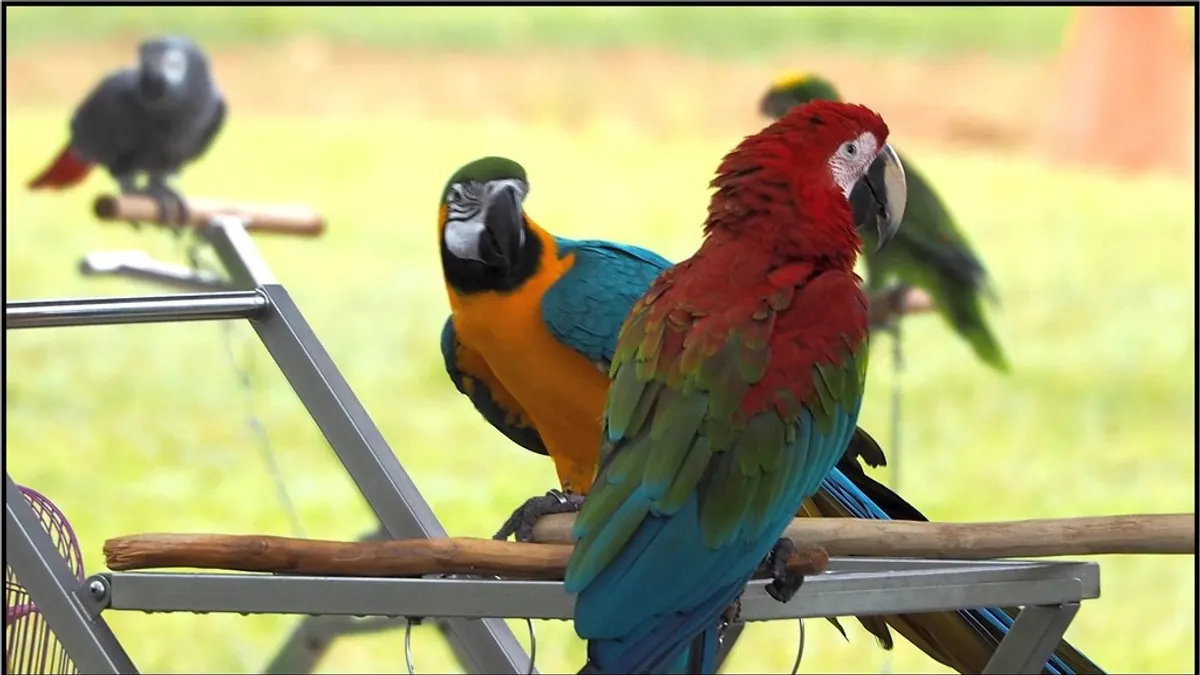
Cover photo: Parrots sunbathing, CC0 1.0, via rawpixel. Cropped.
Related guides
Best Air Purifiers for Bird Dander (2026): Sized by CADR, Not by the Box
Three AHAM-rated HEPA purifiers sized to a bird room by CADR, the 2/3 rule applied to each, and the big-number units left out for publishing no CADR.
Best Bird Cage Cleaning Supplies (2026): Enzyme Sprays, Liners, Baths and Covers
Nine cleaning products judged on label directions, liners by size and count, baths and covers, plus the wash-rinse-disinfect-dry sequence from the sources.
Best Bird Food and Water Dispensers (2026): Stainless Cups, Crocks and Bottles
Nine feeders and waterers from $7 stainless cups to a $41 glass bottle, judged on material, mounting and cleaning against VCA's and PetMD's dish advice.