
How to Set Up a Bird Cage: Perches, Dishes, Floor, Toys and the First Night
Affiliate disclosure: product links on this page go to Amazon, or to the maker's own store for brands that sell only direct. As an Amazon Associate we earn from qualifying purchases, at no extra cost to you; a link to a maker's store earns us nothing. No retailer or brand sees our picks before they are published or has any say in them. How we choose.
A cage arrives as a box of bars, two dowels and two plastic cups, and most of what makes it a home is what you do next. The sequence below is built from PetMD's cage setup article by Dr. Patricia Latas, VCA Animal Hospitals' housing pages, RSPCA Australia's housing advice, the Merck Veterinary Manual's owner pages and, for the wire itself, Howard's 1992 study on galvanized cages. Each step names its source. The cage you start with should already pass the size checker and the bar spacing guide; setup cannot fix a cage that is too small or too open.
1. Inspect the cage before the bird sees it
Run a finger along every bar and weld for burrs, flaking coating and rust; VCA says birds swallow chips. Measure the spacing with a ruler against the Merck table rather than trusting the box (listings print 0.4, 0.5 and 5/8 inch for cages that measure otherwise). If any part is galvanized (shiny grey wire, unpainted hardware), Howard's JAVMA instruction is to wire-brush it and examine it before the bird goes in, and the Niles Animal Hospital sheet adds a vinegar scrub, which reduces the risk without removing it; a cage whose maker states a zinc-free coating (Prevue does) skips this. Check that doors latch and that a parrot's cage has locks a beak cannot open. Remove any plastic or cardboard packing from inside the bars; a bird finds it first.
2. Wash it
Soap and water, rinsed and dried, is the maker's instruction (Prevue: mild soap and water, no abrasives) and the first two steps of the CDFA's cleaning sequence. A new cage does not need disinfecting unless it is second-hand; a used cage gets the full sequence in the cleaning guide before anything goes in it.
3. Perches
Take the dowels out or keep one; VCA wants natural wood of varying diameter so pressure is spread across the foot, toes wrapped about three quarters round, no sandpaper covers, natural cotton or hemp rope allowed and synthetic never, concrete as one perch and not the only one. Dr. Latas adds variety (wood, rope, concrete) and nails reaching about halfway round. RSPCA Australia on placement: perches apart, to make the bird fly or at least climb between them, and never directly above other perches or above food and water, so droppings fall where nothing is. The usual layout is one high perch at the back for sleeping, one low perch near the dishes, and the width of the cage between them, with a platform for a bird that rests flat. The perch guide has the grapevine and rope picks and VCA's wood list; a branch from your own apple or maple, washed and baked at 200°F for 30 minutes (VCA), is the free version.
4. Dishes
VCA: sturdy, non-toxic, cleaned and disinfected daily, attached to the sides not the floor, stainless for large birds, water shallow enough that a small bird cannot get stuck. Three dishes (water, dry food, fresh food) at three places on the sides, none under a perch (RSPCA), plus a second set so one is always drying. The Tfwadmx stainless clamp cups and Lixit's locking crock are in the dish guide. If you plan to use a water bottle, hang it now beside a bowl and keep the bowl until the bottle's level drops every day.
5. The floor
Paper on the tray, changed daily, so the droppings can be read: that is VCA's reason for paper over litter and the owner's daily health check. If the cage has a grille, the paper goes under it. A wire floor without a grille is covered (MSPCA/AAV guidance) so the feet have something flat. Dr. Latas says parrots do not need grit, so the gravel-paper liners sold for the floor are not a reason to buy; plain unprinted newsprint or an absorbent liner from the cleaning guide is.
6. Toys, a few
Two or three toys, rotated, not a cage full; a bird needs room to move more than it needs a tenth toy. Check rope and fabric toys for loose strands (VCA) and small metal parts for what they are made of (the Niles sheet's zinc and lead list). Nothing hangs over the water dish. Toys and swings come out before any car trip (VCA transport page).
7. Seed skirt or catcher
Not a welfare item, a floor item: a stretch mesh skirt around the lower cage catches the seed and feathers that would land on the carpet. The Daoeny skirt (118 by 15.75 inches, $10), the Tamu skirt (stretches 55 to 100 inches, 16 inches deep, $10) and the RAINFLOW two-pack ($7) are the ones we read; measure the cage's perimeter first. A skirt is fabric, so it goes outside the bars where a parrot cannot reach it, and it is washed with the covers.
8. Where it goes
Dr. Latas: where the family is, but not the kitchen or garage, at about chest height, against a wall so the bird has one safe side, away from windows and drafts, not under an overhead lamp that frightens it, and moved if the activity nearby stresses it. Merck's owner page: away from windows, air conditioners and drafts, not the kitchen, comfortable room temperature. VCA's hazards page: never the kitchen or laundry room, because of non-stick fumes. RSPCA: out of the sight and sound of predators, not in the busiest traffic, protected from loud noise. The placement guide goes room by room; the stand it sits on should put the top perch at or below your eye level.
9. The first night and the first week
Dr. Latas: ten to twelve hours of sleep, twelve to fourteen for some, in a dark, quiet room, with the cage covered or the room darkened; Merck's owner page says most birds should not be covered at night. Both agree on the dark and the quiet; whether a cloth is involved depends on your room. The first week is the bird learning the cage: watch that it finds the water (a bottle it has not learned is an empty bottle), that it uses more than one perch, that droppings on the paper look like droppings, and that nothing in the cage has a beak mark that worries you. A new bird also sees an avian veterinarian in its first week for a baseline exam, which every source here takes for granted.
The setup in one table
| Step | Do | Source |
|---|---|---|
| Inspect | Burrs, chips, rust, spacing measured, galvanized brushed, latches | VCA; Merck table; Howard 1992; Niles |
| Wash | Mild soap and water, rinse, dry | Prevue; CDFA |
| Perches | Natural wood, varied diameter, apart, not over food; no sandpaper | VCA; RSPCA; PetMD |
| Dishes | Three on the sides, stainless for big birds, shallow water, washed daily | VCA |
| Floor | Paper changed daily; wire covered; no grit | VCA; MSPCA/AAV; PetMD |
| Toys | Two or three, checked for strands and metal | VCA; Niles |
| Skirt | Outside the bars, washed | Housekeeping |
| Place | Family room, wall behind, no kitchen, no drafts, no fans | PetMD; Merck; VCA; RSPCA |
| Night | 10 to 14 h dark and quiet; cover optional, sources split | PetMD; Merck |
Frequently asked questions
How many perches should a bird cage have?
Enough to give the bird a high sleeping perch, a low one near the dishes and a reason to move between them, in more than one diameter (VCA), placed apart and never above food, water or other perches (RSPCA Australia). Two or three well placed beats six crowded.
Where should food and water bowls go in a bird cage?
Attached to the sides, not on the floor (VCA), away from the perches so droppings do not land in them (RSPCA), water at one end and food at the other. Stainless for large birds; washed and disinfected daily.
What should I put on the bottom of a bird cage?
Paper, changed daily, so droppings can be seen (VCA): unprinted newsprint or an absorbent liner. Parrots do not need grit (PetMD), so gravel paper is not a reason. Cover a bare wire floor.
Do I need to wash a new bird cage?
Yes, with mild soap and water, rinsed and dried (Prevue's care instruction and the first steps of the CDFA sequence). Wire-brush and inspect any galvanized part first (Howard 1992). A second-hand cage gets the full disinfecting sequence.
How many toys should be in a bird cage?
Two or three, rotated, leaving room to move. Check rope and fabric for loose strands (VCA) and small metal parts for zinc and lead (Niles Animal Hospital). Nothing over the water dish.
Should I cover the cage the first night?
Both PetMD and Merck want a dark, quiet room for 10 to 14 hours. PetMD says cover or darken the room; Merck's owner page says most birds should not be covered. In a dark bedroom a cover adds nothing; in a lit living room it is the tool.
Sources
- How to Set Up the Perfect Bird Cage, PetMD (Dr. Patricia Latas, DVM)
- Housing Small Birds, VCA Animal Hospitals
- Housing Large Birds, VCA Animal Hospitals
- Household Hazards and Dangers to Birds, VCA Animal Hospitals
- How to help your pet bird have a good life, RSPCA Australia
- Providing a Home for a Pet Bird, Merck Veterinary Manual
- Minimum and Bar Spacing Recommendations (table), Merck Veterinary Manual
- Howard BR. Health risks of housing small psittacines in galvanized wire mesh cages. J Am Vet Med Assoc 1992;200(11):1667-74, Journal of the American Veterinary Medical Association (PubMed)
- Lead and Zinc Toxicoses in Pet Birds (Peter S. Sakas, DVM), Niles Animal Hospital and Bird Medical Center
- Bird housing: cleaning and disinfecting, California Department of Food and Agriculture
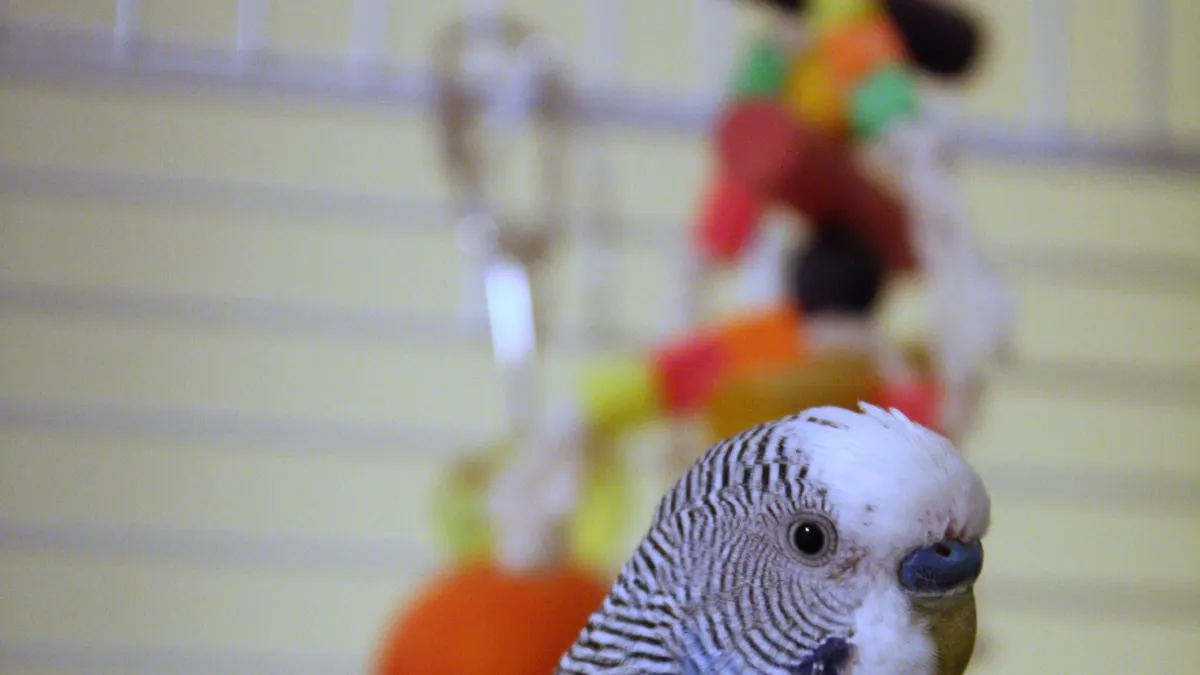
Cover photo: Melopsittacus undulatus -pet in cage -male-8a by Anne Hornyak from Griffith, IN, USA, CC BY-SA 2.0, via Wikimedia Commons. Cropped.
Related guides
Bird Cage Bar Spacing Guide: The Right Gap for Every Species, and Why
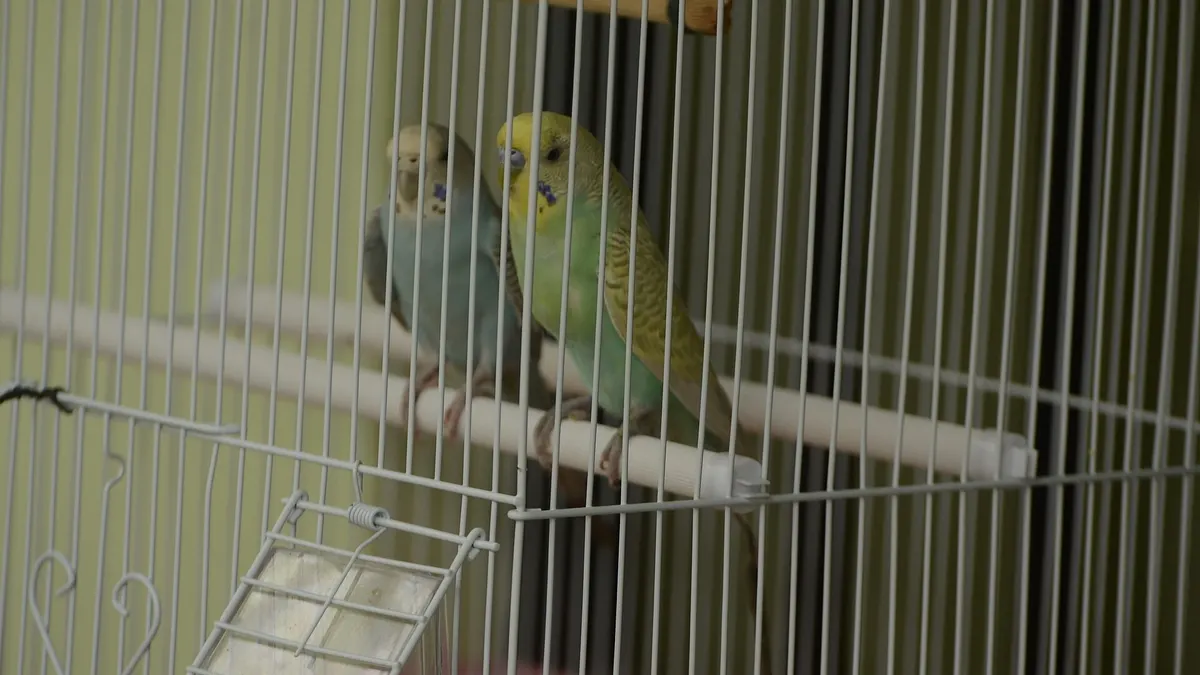
The Merck bar-spacing figures by species, the finger test, why gauge matters as much as gap for big birds, and cages that match each figure.
Bird Cage Buying Guide: Size, Spacing, Material, Doors, Tray and Price, in Order
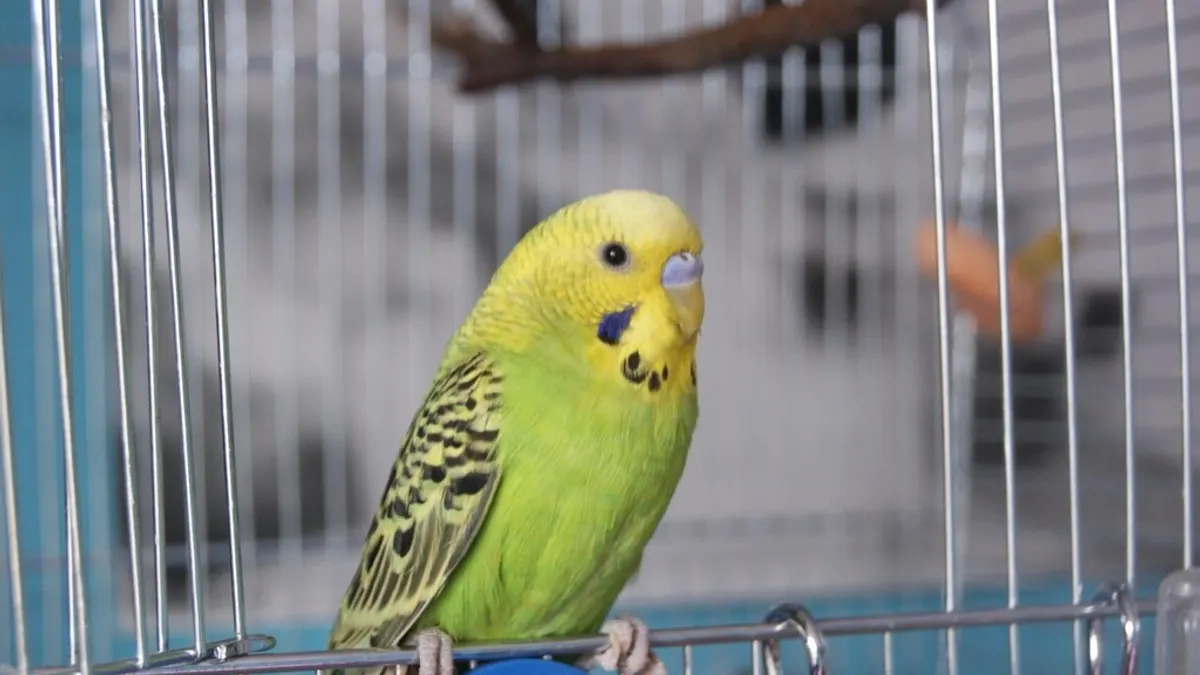
The checks in order before buying any cage: species minimum, spacing and gauge, material, shape, doors, tray, stand, the listing's traps and the price by size class.
Bird Cage Cleaning and Disinfecting Guide: Daily, Weekly and the Full Sequence
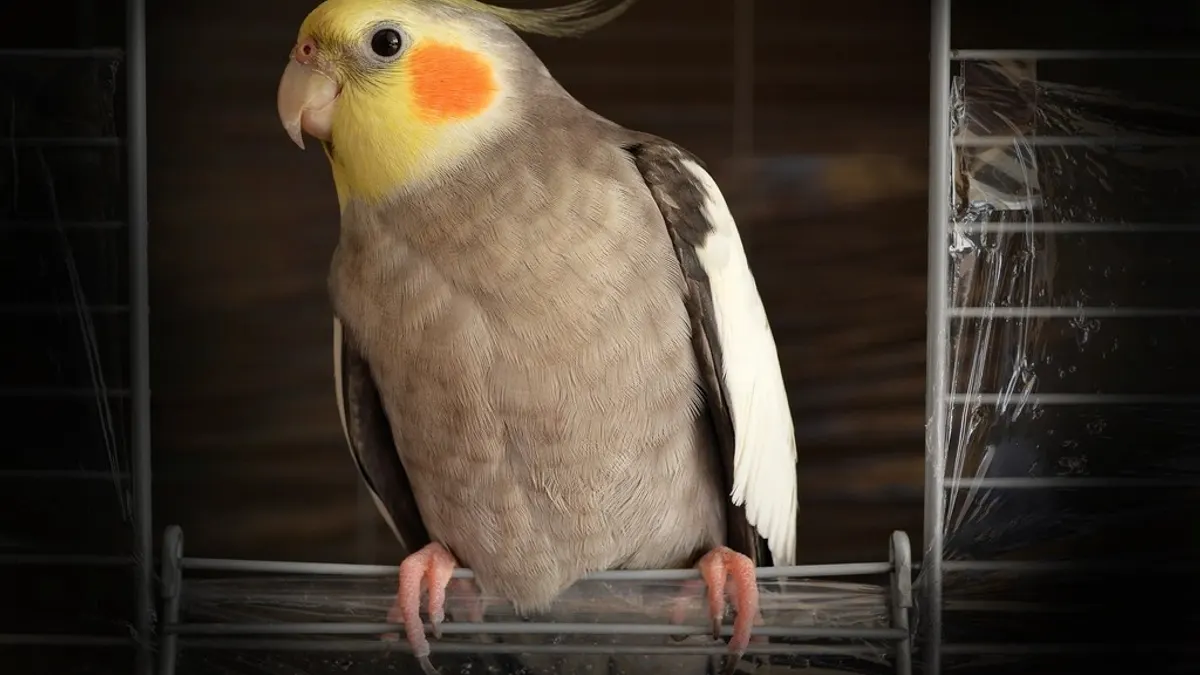
The daily routine from VCA and PetMD, the CDFA's six-step deep clean with label-only disinfecting, and the products and fumes to keep out of a bird room.