
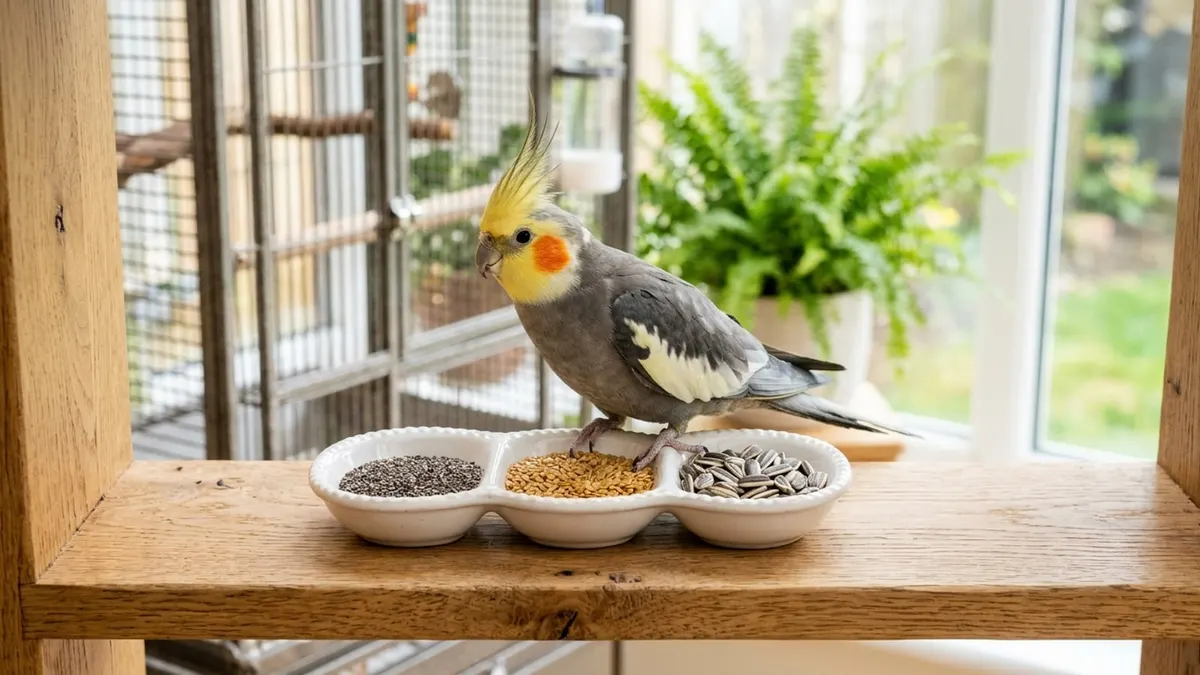
Can Birds Eat Chia, Flax and Sunflower Seeds? What Vet Sources Say
Affiliate disclosure: product links on this page go to Amazon or to the maker's own store. As an Amazon Associate we earn from qualifying purchases, and VEVOR pays us a commission on sales through our VEVOR links, at no extra cost to you; links to other makers' stores earn us nothing. No retailer or brand sees our picks before they are published or has any say in them. How we choose.
Yes, pet birds can eat chia, flax and sunflower seeds in small amounts. None of the three is on Pet Poison Helpline's list of foods that poison birds, and Harrison's and ZuPreem already grind them into their pellets. All three are oil seeds, though. USDA figures put sunflower kernels at 51% fat, flaxseed at 42% and chia at 31%, while the Merck Veterinary Manual sets 5% to 12% fat for a parrot's whole diet. Offer them plain and unsalted, as part of the seed share or as training treats, never as the base of the diet.
The three seeds are not equal. Chia and flax are rich in the omega-3 fat alpha-linolenic acid (ALA): 17.8 g and 22.8 g per 100 g in USDA's data. A Texas A&M feeding trial found that monk parakeets turn the ALA in flaxseed into the long-chain omega-3s EPA and DHA. Sunflower kernels carry almost no omega-3 and little calcium, and VCA Animal Hospitals' vets name sunflower seeds and peanuts as the seeds parrots pick out first. Below: the numbers side by side, how much to give, which birds should get the least, and wild birds at a feeder.
Chia, flax and sunflower seeds side by side
Chia, flax and sunflower seeds differ most in three numbers: fat, calcium and omega-3. The table compares them with sesame, safflower, millet (which VCA names with black sunflower seeds as the seeds owners commonly offer) and one maintenance pellet.
| Food | Fat | Protein | Calcium | Phosphorus | Ca:P | Omega-3 (18:3) | Omega-6 (18:2) |
|---|---|---|---|---|---|---|---|
| Chia seeds, dried | 30.7 g | 16.5 g | 631 mg | 860 mg | 0.73 to 1 | 17.8 g | 5.8 g |
| Flaxseed | 42.2 g | 18.3 g | 255 mg | 642 mg | 0.40 to 1 | 22.8 g | 5.9 g |
| Sunflower kernels, dried | 51.5 g | 20.8 g | 78 mg | 660 mg | 0.12 to 1 | 0.06 g | 23.1 g |
| Sesame seeds, whole, dried | 49.7 g | 17.7 g | 975 mg | 629 mg | 1.55 to 1 | 0.38 g | 21.4 g |
| Safflower kernels, dried | 38.4 g | 16.2 g | 78 mg | 644 mg | 0.12 to 1 | 0.11 g | 28.1 g |
| Millet, raw | 4.2 g | 11.0 g | 8 mg | 285 mg | 0.03 to 1 | 0.12 g | 2.0 g |
| Harrison's Adult Lifetime Fine and Super Fine (pellet) | 7.1 g | 15.4 g | 460 mg | 380 mg | 1.21 to 1 | 0.37 g (total omega-3) | 2.73 g (total omega-6) |
Fat. The Merck Veterinary Manual's chapter on nutrition in psittacines says parrot diets should contain 5% to 12% fat, and that too much fat, especially in sedentary pet birds, leads to obesity, metabolic disease, heart disease and atherosclerosis. Gram for gram, sunflower kernels carry about 7 times the fat of the Harrison's pellet, flaxseed about 6 times and chia about 4 times; millet carries a little over half as much (our arithmetic from the table).
Calcium. Merck's owner page on nutritional disorders says seed-based diets are low in calcium and vitamin D and high in phosphorus, and that the three have to stay in balance. The pellet has more calcium than phosphorus. Of the seeds, only sesame does. Sunflower kernels have 78 mg of calcium against 660 mg of phosphorus; chia has about 8 times sunflower's calcium.
Omega-3. Chia and flax are the omega-3 seeds. Sunflower is almost all omega-6: about 384 g of linoleic acid for every 1 g of ALA (our arithmetic). Birds need some omega-6 too; Merck says at least 1% of a parrot's dry diet should be polyunsaturated fat such as linoleic acid.
Can birds eat chia seeds?
Birds can eat chia seeds, and the clearest sign is that Harrison's puts organic chia in its Adult Lifetime and High Potency Fine and Super Fine nuggets. Harrison's ingredient notes describe chia as rich in omega-3 fatty acids, soluble fiber, protein, vitamins and minerals. USDA's figures agree: 17.8 g of ALA, 34.4 g of fiber and 631 mg of calcium per 100 g, more fiber than flax, sesame, sunflower or millet in USDA's data.
Chia is still 30.7% fat, about 2.5 to 6 times the 5% to 12% Merck sets for a whole parrot diet (our arithmetic). No veterinary source on this page gives a daily amount of chia for a pet bird, so count it inside the seed share. A pinch over chopped vegetables works. Soaked chia turns to a gel, so clear it away with the vegetables: VCA says fresh produce should stay in the cage no more than a couple of hours, or it may spoil.
Can birds eat flax seeds?
Birds can eat flax seeds, and flax is the one of the three with a feeding study behind it. ZuPreem lists ground flaxseeds in every size of its Natural pellets, from small birds to macaws. At Texas A&M, researchers fed 24 monk parakeets (Quaker parrots) a diet with either 10% ground sunflower seed or 10% ground flaxseed (Petzinger and others, 2014). By day 70, the flaxseed group had significantly higher blood levels of ALA, EPA and DHA, and the sunflower group had more arachidonic acid, an omega-6. The authors concluded that monk parakeets readily convert ALA into the long-chain omega-3s.
Why that might matter: atherosclerosis, fatty plaque in the arteries, is common in pet parrots. A Utrecht University study of 202 dead parrots found that it increased with age and that African greys appeared the most susceptible. Parrots without atherosclerosis had significantly higher ALA levels in their tissues, and the authors suggested, tentatively, that a high ALA intake protects. That is an association, not proof, and a follow-up flaxseed oil trial in monk parakeets found blood cholesterol and triglycerides unchanged as ALA went up.
Flaxseed oil is a supplement, not a food. VCA says omega fatty acid supplements should only be given under the guidance of a veterinarian who knows birds; Merck's professional chapter lists flaxseed oil, dosed by body weight, as one part of treating metabolic bone disease.
Can birds eat sunflower seeds?
Birds can eat sunflower seeds, but sunflower is the seed avian vets warn about most. Merck's nutritional diseases chapter says sunflower seeds, which many parrots pick out first, are low in calcium, deficient in essential amino acids and high in fat. VCA's African grey feeding page says greys often choose peanuts and sunflower seeds, which are particularly high in fat and deficient in calcium and vitamin A, and VCA says the same on its Amazon, macaw, conure and cockatoo pages. USDA puts sunflower kernels at 51.5 g of fat per 100 g.
The harm comes from the habit, not the seed. Merck says obesity in pet birds comes from high-fat diets (seeds, nuts and many table foods), too much food and too little exercise; a bird is obese at 20% over its ideal weight, and obesity raises the risk of arthritis, fatty liver disease, atherosclerosis and heart disease. Harrison's still uses sunflower kernels in its pellets, describing them as packed with fat and protein plus B vitamins and trace minerals. Ground into a balanced pellet, they cannot be picked out.
Sunflower seeds work best as rewards. Merck's management chapter says seeds and nuts can be given to larger parrots occasionally as treats or for training, and one kernel at a time is easy to count. Pantry sunflower seeds are often roasted and salted: VCA says to avoid very salty food such as chips and pretzels, so offer plain, unsalted seeds only.
Safflower is often sold as the leaner swap. Merck says safflower seeds are actually higher in fat than sunflower seeds and also short of amino acids and calcium. USDA's kernel figures put safflower lower in fat (38.4 g against 51.5 g per 100 g) but equal on calcium (78 mg each). Either way, safflower carries about 9 times millet's fat (our arithmetic).
Which birds should get the least sunflower
Sunflower and other fatty seeds matter more for some species than others. The table lists the birds the sources single out.
| Bird | Why the sources flag it | Source |
|---|---|---|
| Amazon parrots, Quaker parrots, galahs, macaws | Especially likely to become obese | Merck (owner page) |
| African greys | Acute low blood calcium is more common in greys fed all-seed diets; most susceptible to atherosclerosis in the Utrecht study | Merck (owner page); Bavelaar and Beynen, 2003 |
| Budgies (parakeets) | Vulnerable to obesity and iodine deficiency | VCA (budgies) |
| Hyacinth macaws | The exception: their wild diet is mostly high-fat palm nuts, and Merck says nuts can make up 15% of their daily diet | Merck (nutrition in psittacines) |
For a grey, calcium is the bigger worry, and our African grey food guide compares pellet labels on calcium and vitamin D.
How much chia, flax or sunflower to give
No veterinary source gives a teaspoon figure for these seeds, so the amount comes from the diet split. Merck's management chapter recommends 40% to 50% pellets and 30% to 40% seed mix for budgies, cockatiels and lovebirds, plus 10% to 15% vegetables and 5% to 10% fruit. For larger parrots it recommends 80% pellets, 10% to 15% vegetables and 5% to 10% fruit, with seeds and nuts only as occasional treats or for training. VCA is stricter: seeds should be only a very small part of a budgie's diet. Chia, flax and sunflower belong inside those shares, not on top.
The scale is the check. Merck notes that obesity can be hard to notice and says owners should weigh birds weekly. If the weight climbs, the fatty seeds are the first thing to cut.
The simplest way to give a bird chia, flax and sunflower without the fat problem is a pellet that already contains them. Harrison's Adult Lifetime Super Fine (for budgies, lovebirds, canaries and finches) and Adult Lifetime Fine (for cockatiels and Quakers) list organic sunflower kernels and chia at 7.1% fat as fed. ZuPreem's Natural pellets, sold on Amazon as ZuPreem True Harvest, list ground flaxseeds and guarantee at least 4% fat. Both are sold on Amazon either by Amazon itself or by the maker's own store, never by a reseller.
Our parakeet food guide and cockatiel food guide compare more pellet labels, and what do parakeets eat sets out a full day's menu for a budgie.
A checklist for feeding chia, flax and sunflower seeds
- Plain, raw and unsalted only; no roasted snack seeds.
- Count them inside the seed share (small birds) or the treat share (larger parrots), never on top.
- Sunflower as a training reward, one kernel at a time.
- Chia or flax as a pinch over vegetables, cleared away with the vegetables within a couple of hours.
- Throw out seed that smells musty or shows mold: Merck links liver damage to aflatoxin from badly stored seed.
- Flaxseed oil and other omega supplements only on an avian vet's advice (VCA).
- Weigh the bird weekly (Merck).
Seeds birds should never eat
The seeds to keep away from birds are fruit seeds and pits, not chia, flax or sunflower. Pet Poison Helpline says some fruit seeds and pits contain cyanide-forming compounds, that birds crack them open and reach it, and that signs can start 1 to 2 hours after eating. Take the pits and seeds out of fruit before it goes in the bowl; VCA's budgie list names "cherries without pit". Our bird toxins database lists 56 hazards, from avocado to fumes.
Can wild birds eat chia and flax seeds?
Wild birds can eat chia and flax, but feeder experts do not list them. The Cornell Lab's Project FeederWatch food types page covers black-oil sunflower, hulled sunflower, safflower, nyjer, millet, milo, cracked corn, oats, peanuts, fruit, mealworms, suet and sugar water, with no chia or flax. FeederWatch says black-oil sunflower is the most common seed offered at North American feeders: high in energy, thin-shelled, and a favorite of cardinals, chickadees, finches and sparrows.
Hulled "no mess" sunflower cuts the shells under the feeder, but FeederWatch says to keep it dry because it spoils faster than seed in the shell. For the indoor version of the mess problem, our no-mess bird food guide shows what each food type leaves in the cage tray.
Frequently asked questions
Can birds eat chia seeds?
Yes, in small amounts. Harrison's puts organic chia in its Adult Lifetime and High Potency pellets, and USDA lists chia at 17.8 g of omega-3 ALA and 631 mg of calcium per 100 g. Chia is also 30.7% fat, so count it inside the seed share of the diet rather than adding it on top.
Can parrots eat flax seeds?
Yes. ZuPreem's Natural pellets contain ground flaxseeds, and a Texas A&M trial fed monk parakeets a diet with 10% ground flaxseed for 70 days; their blood levels of the omega-3s ALA, EPA and DHA rose. Flaxseed is 42.2% fat in USDA's data, so keep the amount small. Flaxseed oil is a supplement and should only be given on an avian vet's advice.
Are sunflower seeds bad for birds?
Not in small amounts, but they are the seed vets warn about most. The Merck Veterinary Manual says sunflower seeds are low in calcium, deficient in essential amino acids and high in fat, and that many parrots pick them out first. USDA puts the kernels at 51.5% fat. Use them as training rewards, one at a time.
Can birds eat roasted or salted sunflower seeds?
Offer plain, unsalted seeds only. VCA Animal Hospitals says to avoid very salty food such as chips and pretzels, and Project FeederWatch tells feeder hosts to avoid salted peanuts or peanuts roasted with coatings or flavorings. Roasted, salted snack seeds belong in the same group.
Can birds eat sesame seeds?
Yes, in small amounts. Harrison's lists organic sesame seeds among its functional ingredients. Sesame is the only seed in our table with more calcium than phosphorus (975 mg against 629 mg per 100 g in USDA's data), but it is also 49.7% fat, nearly as much as sunflower kernels.
Do chia seeds need to be soaked for birds?
None of the veterinary sources we read requires it. Dry chia can go over chopped vegetables. Soaked chia turns to a gel and should be treated like fresh food: VCA says fresh fruits and vegetables should stay in the cage no more than a couple of hours, or they may spoil.
Can wild birds eat chia seeds?
They can, but feeder experts do not list chia. The Cornell Lab's Project FeederWatch food guide covers sunflower, safflower, nyjer, millet, peanuts and more, with no chia or flax. FeederWatch says black-oil sunflower is the most common feeder seed in North America and a favorite of cardinals, chickadees, finches and sparrows.
Sources
- Nutritional Diseases of Pet Birds, Merck Veterinary Manual (Sharman M. Hoppes, DVM)
- Nutritional Disorders of Pet Birds, Merck Veterinary Manual (Laurie Hess, DVM)
- Nutrition in Psittacines, Merck Veterinary Manual
- Management of Pet Birds, Merck Veterinary Manual (Sharman M. Hoppes, DVM)
- African Grey Parrots - Feeding, VCA Animal Hospitals
- Budgies - Feeding, VCA Animal Hospitals
- Conversion of alpha-linolenic acid to long-chain omega-3 fatty acid derivatives ... in Monk parrots (Myiopsitta monachus), Journal of Animal Physiology and Animal Nutrition, 2014 (Petzinger C, Larner C, Heatley JJ, Bailey CA, MacFarlane RD, Bauer JE), via PubMed
- Severity of atherosclerosis in parrots in relation to the intake of alpha-linolenic acid, Avian Diseases, 2003 (Bavelaar FJ, Beynen AC), via PubMed
- Seeds, sunflower seed kernels, dried (and the chia, flaxseed, sesame, safflower and millet entries linked in the table), USDA FoodData Central (SR Legacy)
- Food Types, Project FeederWatch, Cornell Lab of Ornithology
Cover image: Illustration: Bird Cage Review (AI-generated)
Related guides
What Do Cockatiels Eat? A Vet-Based Daily Diet for Cockatiels
The daily cockatiel diet from VCA and Merck: pellet, produce and seed shares, vitamin A foods, a cockatiel vitamin A study, hen calcium and toxic foods.
Best Finch and Canary Food (2026): Pellets, Seed and Egg Food Compared
Six finch and canary foods compared on the makers' own labels against VCA's and Merck's figures, with daily servings that differ by three times.
Best Lovebird Food (2026): Five Pellets and Blends Held to Vet Figures
Five lovebird foods compared on the makers' own labels against VCA's and Merck's diet figures, with the calcium levels only one maker publishes.