
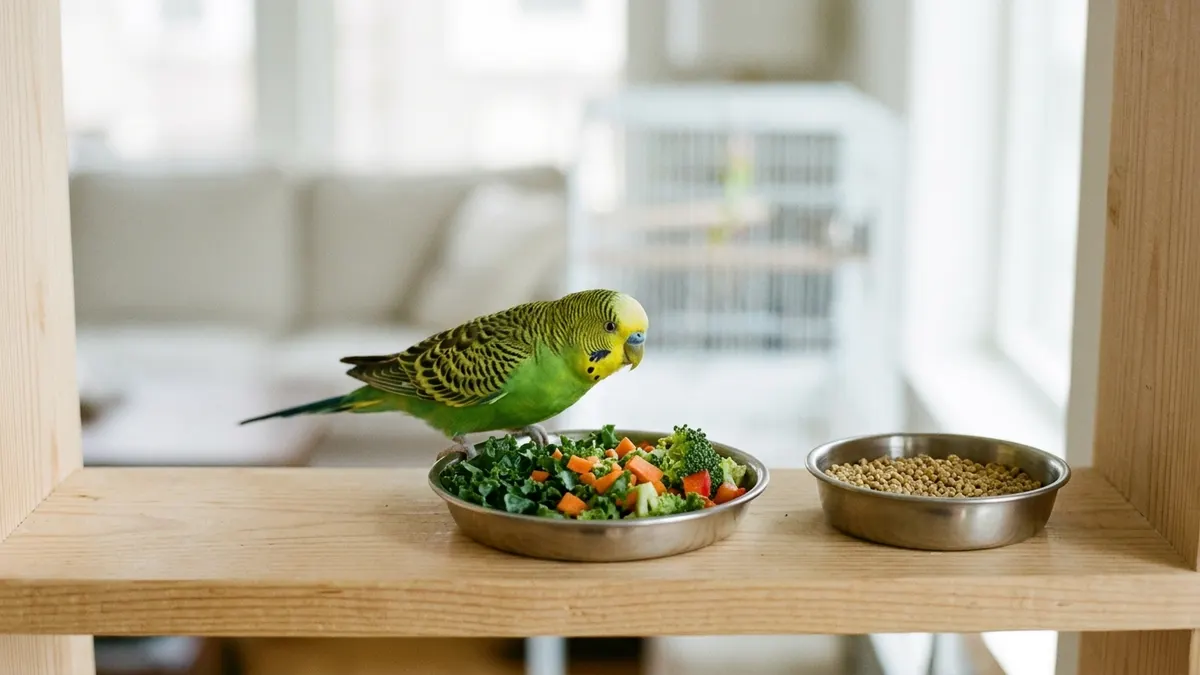
What Do Parakeets Eat? A Vet-Based Daily Diet for Budgies
Affiliate disclosure: product links on this page go to Amazon or to the maker's own store. As an Amazon Associate we earn from qualifying purchases, and VEVOR pays us a commission on sales through our VEVOR links, at no extra cost to you; links to other makers' stores earn us nothing. No retailer or brand sees our picks before they are published or has any say in them. How we choose.
Pet parakeets (budgies) should eat a small-bird pellet as most of the diet, fresh vegetables and some fruit every day, and seed only as a small share. VCA Animal Hospitals' avian vets put pellets at about 60% to 80% of a budgie's diet and fruit, vegetables and greens at 20% to 25% at most. The Merck Veterinary Manual allows more seed for small birds: 40% to 50% pellets, 30% to 40% seed mix, 10% to 15% vegetables and 5% to 10% fruit. Fresh water goes in every day, and avocado, chocolate, caffeine, alcohol and salty snacks never go in the bowl.
This guide is for anyone feeding a budgerigar, the bird US pet stores sell as a parakeet. It covers what wild budgies eat and why a seed mix is not the same thing, the vegetables and fruits VCA lists for budgies, the human foods to keep away, and how much one bird eats in a day. Every figure comes from a veterinary source, a natural history reference or the food maker's own feeding directions, linked on the page. For the pellets themselves, our best parakeet food guide compares five labels.
What parakeets eat in a day: the vet splits
A pet parakeet's daily diet has three parts: a formulated food (pellets), fresh produce and a little seed. The two veterinary sources and one food maker put the shares at different levels, so here are all three side by side.
| Source | Pellets | Seed | Vegetables and fruit |
|---|---|---|---|
| VCA Animal Hospitals (budgies) | About 60% to 80% | A very small part, never the whole diet | 20% to 25% at most |
| Merck Veterinary Manual (budgerigars, cockatiels, lovebirds) | 40% to 50% | 30% to 40% seed mix | 10% to 15% vegetables plus 5% to 10% fruit |
| Harrison's Bird Foods (its own feeding directions) | 75% to 80% Harrison's | None named | 15% to 20% dark green leafy or dark yellow vegetables and fruits |
VCA is the stricter source on seed. Merck allows a seed mix for small birds, but its own chapter warns that a bowl of pellets and seeds mixed together lets the bird pick what it likes and miss nutrients. Both agree that a parakeet on seed alone is underfed in vitamins and minerals. Your avian vet can set the split for your bird, especially for a bird that is young, laying eggs, raising chicks or overweight.
What that looks like for one budgie
- Pellets: ZuPreem's feeding directions for its small pellets say 1 to 3 tablespoons a day for parakeets and budgies, adjusted to the bird's body condition. Harrison's says to put out fresh food daily.
- Fresh food: VCA says a thumbnail-size portion of table food for a budgie is the same as a dinner plate for a person. Serve produce in its own dish and take it out after no more than a couple of hours.
- Water: clean water at all times, with dishes or bottles washed daily in soap and water (VCA). Wild budgies drink about 5.5% of their body weight a day, per the Animal Diversity Web; for a 30 g bird that is about 1.7 mL (our arithmetic).
Our best parakeet food guide compares five pellets on protein, fat, sugar and dyes. Two of them are sold on Amazon by Amazon itself or by the maker's own store, never by a reseller: ZuPreem True Harvest Small, a pellet ZuPreem says is made with 100% natural ingredients and names for parakeets and budgies, and Harrison's Adult Lifetime Super Fine, a certified organic maintenance pellet Harrison's names for budgies.
What wild parakeets eat, and why a seed mix is not the same
Wild budgerigars in Australia eat mostly seeds. The Australian Museum says they feed almost entirely on the seeds of native herbs and grasses, such as porcupine grass and saltbush, picked mostly from the ground, with most feeding and drinking done in the morning. The Animal Diversity Web names spinifex and tall tussock grasses and says budgies hull each seed before swallowing it. VCA adds that wild budgies also take fruits, berries and vegetation, and that what they eat changes with the season.
A pet-store seed mix is a narrow copy of that diet. VCA says commercial mixes contain two to eight kinds of seed, run high in fat and carbohydrate and low in protein, and lack essential vitamins and minerals. Budgies also pick out one or two favorites, often millet, which VCA calls deficient in many nutrients. Merck says the seed mixes fed before pellets existed were high in fat and short of calcium and vitamin A.
Budgies have one diet problem of their own. Merck's chapter on nutritional diseases says goiter, an enlarged thyroid, occurs in budgerigars on all-seed diets short of iodine, with wheezing or clicking as the classic signs. It is no longer common, Merck says, because pellets and fortified diets are available. VCA lists obesity and iodine deficiency among the problems budgies are prone to.
Vegetables and fruits parakeets can eat
Parakeets can eat a long list of vegetables and fruits, cut small. The groups below come from VCA's list of fruits and vegetables suited to budgies, with notes from Harrison's and Pet Poison Helpline. Wash produce well, cut it to budgie size (the skin can stay on, VCA says), and serve it in a separate dish from the pellets.
| Group | Examples on VCA's budgie list | Note |
|---|---|---|
| Dark leafy greens | Kale, romaine lettuce, spinach, bok choy, dandelion leaves, endive, carrot tops, rapini | Harrison's names dark green leafy vegetables first. VCA says iceberg lettuce offers little. |
| Orange and yellow vegetables | Carrot, sweet potato, pumpkin, squash | Harrison's names dark yellow meaty vegetables; its examples include sweet potatoes, carrots, pumpkin and winter squash. |
| Other vegetables | Broccoli, peppers, peas, corn, zucchini, asparagus, Brussels sprouts, cabbage, beet, parsnip, cucumber | VCA says celery, pale and watery, offers little. |
| Fruit with pits or seeds | Apple, cherries, peaches, nectarines, plums, apricots | Take out every pit and seed first. Pet Poison Helpline says birds crack them open and reach the cyanide-forming compounds inside. |
| Other fruit | Banana, blueberry, raspberry, strawberry, grapes, mango, papaya, melons, kiwi, orange, pear, pineapple, pomegranate | Fruit is 5% to 10% of the diet in Merck's split. |
| Cooked and sprouted | Cooked beans, brown rice, sprouted seeds | Served plain; VCA says avoid food cooked with butter or oil. |
If a parakeet fixes on one item, VCA says to cut back or stop that food for a while so it eats the others. Produce left in a warm cage spoils, so take it out within a couple of hours. A bird that dunks food in its water bowl dirties it fast; the Merck owner pages suggest a water bottle, and our food and water dispenser guide covers the hardware.
Human foods parakeets should never eat
Parakeets can share plain, wholesome food from the family table in tiny amounts, VCA says, but not processed food or anything cooked in butter or oil, and dairy only in moderation because birds are lactose-intolerant. Some foods are never fed at all.
| Food | What it does to a bird | Source |
|---|---|---|
| Avocado (skin, flesh, pit, plant) | Persin; any part can cause heart abnormalities and death, and there is no antidote | University of Illinois; VCA |
| Chocolate, coffee, tea, soda | Stimulants: overexcitement, tremors, seizures | University of Illinois; VCA |
| Onions, garlic, leeks, chives | Damage red blood cells, causing severe anemia | University of Illinois |
| Alcohol | Never to be fed | VCA |
| Chips, pretzels, popcorn | Very salty; never to be fed | VCA |
| Moldy food (grains, peanuts, bread, cheese) | Mycotoxins; signs can start within 2 to 3 hours, even from a small amount | Pet Poison Helpline |
| Fruit pits and seeds | Cyanide-forming compounds; signs within 1 to 2 hours | Pet Poison Helpline |
If a parakeet eats any of these, call an avian vet or a poison line at once. The Illinois column gives the ASPCA Animal Poison Control number, (888) 426-4435. Our bird toxins database lists 56 hazards, from foods to fumes and plants.
Seed, millet and treats for parakeets
Seed can stay in a parakeet's diet as a small, measured part. VCA says seeds lack vitamins, minerals and protein, so they should be only a very small part of a budgie's diet and never all of it. Millet spray is a treat: VCA says small amounts once or twice a month. Honey sticks, seeds stuck together with sugar and honey, are not recommended by most avian vets, and VCA says molting, song and conditioning foods are only other seed blends. Our guide to chia, flax and sunflower seeds for birds compares the fat, calcium and omega-3 in those seeds.
Parakeets do not need grit. VCA says budgies hull their seeds before eating the kernel, so grit does no work for them, and some budgies eat too much of it and block their gut. VCA's advice is not to offer grit or gravel at all.
Vitamin powders matter only for a bird still on seed. VCA says a bird getting 75% to 80% of its diet from pellets generally needs no extra vitamins, that powder on seed is of little value because the bird discards the hull, and that supplements should be given only on an avian vet's advice. Harrison's says the same for its food. A hen laying eggs needs calcium, VCA notes, which is a question for the vet.
Switching a parakeet from seed to pellets
Switching a seed-eating parakeet to pellets takes days, weeks or months, VCA says, and going too fast can leave a thin, sick bird, Merck warns. Merck's schedule mixes 20% pellets with 80% seed for about two weeks, then moves to 30%, 50%, 75% and 100% pellets with two weeks at each step.
- Weigh the budgie on a gram scale before you start and through the switch. Merck says to call the vet if the bird loses more than 10% of its body weight; for a 30 g budgie (the Animal Diversity Web's average) that is 3 g (our arithmetic). If you cannot weigh it, watch the droppings: fewer droppings means call the vet.
- Offer pellets first thing in the morning, when the bird is hungriest (VCA and Merck).
- Budgies feed on the ground in the wild, so VCA suggests spreading pellets on a flat surface and tapping at them with a fingertip, the way another bird would peck.
- VCA also suggests grinding pellets to a powder and dusting it on a moist food the bird already eats, such as vegetables, cooked egg or pasta, then making the pieces bigger over time.
- Remove the seed only once you are sure the bird is eating pellets and some fresh food.
The parakeet food guide has the label comparison and Harrison's faster four-week plan. Pellets also make less mess than a seed mix, because there are no hulls; our no-mess bird food guide shows what each food type leaves in the tray.
A daily feeding checklist for one parakeet
- Morning: fresh pellets in a clean dish, 1 to 3 tablespoons by ZuPreem's guide, adjusted to the bird.
- Fresh vegetables and some fruit in a separate dish, cut small, out for no more than a couple of hours.
- Clean water, with the dish or bottle washed daily.
- Seed, if any, measured and kept to a small share; millet spray once or twice a month at most.
- No grit, no avocado, no chocolate, caffeine, alcohol or salty snacks.
- Weigh the bird on a gram scale; Merck's section on obesity says owners should weigh birds weekly.
Food and water dishes need room in the cage too. Our parakeet cage guide sizes the cage to the bird from the avian sources.
Frequently asked questions
What do parakeets eat every day?
A small-bird pellet as most of the diet, fresh vegetables and some fruit, and a little seed. VCA Animal Hospitals puts pellets at about 60% to 80% of a budgie's diet and fruit and vegetables at 20% to 25% at most. Clean water must be there at all times.
What fruits can parakeets eat?
VCA's list for budgies includes apple, banana, berries, grapes, mango, papaya, melons, kiwi, orange, pear, pineapple and pomegranate, plus pitted cherries, peaches, plums and apricots. Take out every pit and seed first: Pet Poison Helpline says birds crack them open and reach cyanide-forming compounds. Never feed avocado.
What vegetables can parakeets eat?
Dark leafy greens such as kale, romaine, spinach and bok choy, orange vegetables such as carrot, sweet potato, pumpkin and squash, and broccoli, peppers, peas, corn and zucchini all appear on VCA's budgie list. VCA says iceberg lettuce and celery offer little because they are mostly water.
How much do parakeets eat a day?
Not much. ZuPreem's feeding directions for its small pellets say 1 to 3 tablespoons a day for a parakeet, adjusted to body condition. VCA says a thumbnail-size portion of table food is the budgie equal of a dinner plate for a person. A gram scale is the simplest check that the amount is right.
Can parakeets eat bread and other human food?
Plain, wholesome food in tiny amounts, VCA says, but not processed food or anything cooked in butter or oil, and dairy only in moderation. Moldy bread or grains are dangerous: Pet Poison Helpline says mycotoxins can cause signs within 2 to 3 hours.
Can parakeets live on seeds only?
Vets advise against it. VCA says seeds lack vitamins, minerals and protein and should never be the whole diet, and the Merck Veterinary Manual says goiter occurs in budgerigars on all-seed diets short of iodine. Merck still allows 30% to 40% seed mix for small birds alongside pellets and produce.
Do parakeets need grit?
No. VCA says budgies remove the hull before eating a seed, so grit does no work for them, and some budgies eat too much of it and block their gut. VCA's advice is not to offer grit or gravel at all.
Sources
- Budgies - Feeding, VCA Animal Hospitals (Gregory Rich, DVM; Laurie Hess, DVM; Rick Axelson, DVM)
- Management of Pet Birds, Merck Veterinary Manual (Sharman M. Hoppes, DVM)
- Nutritional Diseases of Pet Birds, Merck Veterinary Manual (Sharman M. Hoppes, DVM)
- Feeding a Pet Bird, Merck Veterinary Manual (Laurie Hess, DVM)
- Melopsittacus undulatus (budgerigar), Animal Diversity Web, University of Michigan (Kelly Sims)
- Budgerigar, Australian Museum
- Bad for Birds: Prevent Poisoning in Avian Pets, University of Illinois College of Veterinary Medicine
- What's Poisonous to Birds and Pocket Pets?, Pet Poison Helpline
- Natural (small bird pellets, feeding directions), ZuPreem
- Adult Lifetime Super Fine, Harrison's Bird Foods
Cover image: Illustration: Bird Cage Review (AI-generated)
Related guides
What Do Cockatiels Eat? A Vet-Based Daily Diet for Cockatiels
The daily cockatiel diet from VCA and Merck: pellet, produce and seed shares, vitamin A foods, a cockatiel vitamin A study, hen calcium and toxic foods.
Best Finch and Canary Food (2026): Pellets, Seed and Egg Food Compared
Six finch and canary foods compared on the makers' own labels against VCA's and Merck's figures, with daily servings that differ by three times.
Best Lovebird Food (2026): Five Pellets and Blends Held to Vet Figures
Five lovebird foods compared on the makers' own labels against VCA's and Merck's diet figures, with the calcium levels only one maker publishes.