
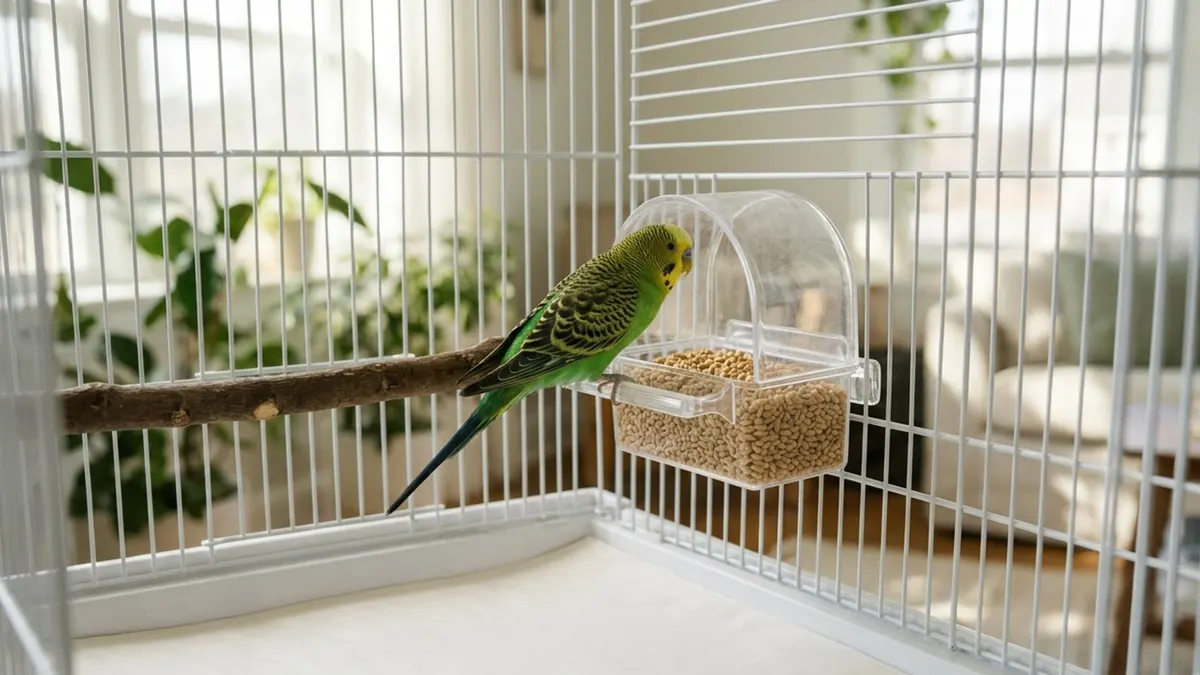
Best No-Mess Bird Food for Caged Birds (2026): Hull-Free Pellets Compared
Affiliate disclosure: product links on this page go to Amazon or to the maker's own store. As an Amazon Associate we earn from qualifying purchases, and VEVOR pays us a commission on sales through our VEVOR links, at no extra cost to you; links to other makers' stores earn us nothing. No retailer or brand sees our picks before they are published or has any say in them. How we choose.
The least messy food you can put in a pet bird's cage is a pellet: there is no hull for the bird to crack off and drop, and nothing in the bowl to sort through and fling. VCA Animal Hospitals' avian vets say budgies, cockatiels, lovebirds and canaries remove the outer hull of every seed before they eat the kernel, and that birds often eat only one or two favorite seeds out of a mix. Our top pick is ZuPreem True Harvest, a dye-free pellet of ground grains that ZuPreem makes in four sizes, from finches to macaws. ZuPreem says its uniform color prevents selective feeding and food waste. The Small size was sold by Amazon itself when we checked on November 9, 2026.
The "no mess" seed that fills the search results is something else: hulled sunflower blends for backyard feeders, which Kaytee labels "only intended for feeding wild birds." This guide is for a bird that lives in a cage. Every pick is a complete diet made mainly from ground, hull-less or hulled grains, not a seed mix, and is sold by Amazon or by the maker's own store.
Our top picks at a glance
- ZuPreem True Harvest, Small (2.25 lb)
Birds the maker names: Parakeets, budgies, parrotlets, canaries, finches · Hulls: None: every grain is ground (per the ingredient list) · Protein / fat (min): 14% / 4% · Sugar or color: Sugar listed; no artificial colors
2. Best for a bird that won't give up seed
Lafeber Classic Nutri-Berries for Cockatiels (4 lb)Birds the maker names: Cockatiels, Quakers, Indian ringnecks, Neophemas · Hulls: Hulled canary grass seed, millet and oats lead the list · Protein / fat (min): 12.8% / 7.0% · Sugar or color: Corn syrup listed; no artificial colors
3. Best organic pellet with no added sugar
Harrison's Adult Lifetime Fine (1 lb)Birds the maker names: Cockatiels, budgies, lovebirds, Quakers, lories, doves · Hulls: None in the shell: hull-less barley, hulled millet, sunflower kernels · Protein / fat (min): 14% / 6% · Sugar or color: None listed; no artificial colors
4. Best for conures, greys and Amazons
ZuPreem True Harvest, Parrots & Conures (M/L, 3 lb)Birds the maker names: Conures, caiques, greys, Senegals, Amazons, eclectus, small cockatoos · Hulls: None: every grain is ground (per the ingredient list) · Protein / fat (min): 14% / 4% · Sugar or color: Sugar listed; no artificial colors
5. Best for macaws and cockatoos
Harrison's Adult Lifetime Coarse (1 lb)Birds the maker names: Pionus, Amazons, cockatoos, macaws · Hulls: None in the shell: hull-less barley, sunflower and peanut kernels · Protein / fat (min): 15% / 5.5% · Sugar or color: None listed; no artificial colors
| Pick | Birds the maker names | Hulls | Protein / fat (min) | Sugar or color | Buy |
|---|---|---|---|---|---|
| ZuPreem True Harvest, Small (2.25 lb)Best overall | Parakeets, budgies, parrotlets, canaries, finches | None: every grain is ground (per the ingredient list) | 14% / 4% | Sugar listed; no artificial colors | Amazon |
| Lafeber Classic Nutri-Berries for Cockatiels (4 lb)Best for a bird that won't give up seed | Cockatiels, Quakers, Indian ringnecks, Neophemas | Hulled canary grass seed, millet and oats lead the list | 12.8% / 7.0% | Corn syrup listed; no artificial colors | Amazon |
| Harrison's Adult Lifetime Fine (1 lb)Best organic pellet with no added sugar | Cockatiels, budgies, lovebirds, Quakers, lories, doves | None in the shell: hull-less barley, hulled millet, sunflower kernels | 14% / 6% | None listed; no artificial colors | Amazon |
| ZuPreem True Harvest, Parrots & Conures (M/L, 3 lb)Best for conures, greys and Amazons | Conures, caiques, greys, Senegals, Amazons, eclectus, small cockatoos | None: every grain is ground (per the ingredient list) | 14% / 4% | Sugar listed; no artificial colors | Amazon |
| Harrison's Adult Lifetime Coarse (1 lb)Best for macaws and cockatoos | Pionus, Amazons, cockatoos, macaws | None in the shell: hull-less barley, sunflower and peanut kernels | 15% / 5.5% | None listed; no artificial colors | Amazon |
Best overall
ZuPreem True Harvest, Small (2.25 lb)
A dye-free pellet with nothing to shell, sized for budgies, parrotlets, canaries and finches, with larger sizes for every other cage bird.
- Birds the maker names
- Parakeets, budgies, parrotlets, canaries, finches
- Hulls
- None: every grain is ground (per the ingredient list)
- Protein / fat (min)
- 14% / 4%
- Sugar or color
- Sugar listed; no artificial colors
Pros
- ZuPreem says the uniform color prevents selective feeding and food waste
- Ground grains only, so there is no husk to crack off
- Sold by Amazon.com in a 2.25 lb bag on November 9, 2026
Cons
- Sugar is in the ingredient list
- Not the whole diet: VCA puts vegetables and fruit at up to 20 to 25% for budgies
- A seed eater needs a slow switch (see below)
True Harvest is ZuPreem's pellet without color additives. The grains are ground before the pellet is formed (the list starts with ground corn, soybean meal, ground millet, ground oat groats, ground barley and ground wheat), so there is nothing for the bird to shell. ZuPreem's directions say to discard uneaten food before each feeding. The guaranteed analysis is 14% protein minimum, 4% fat minimum and 5% fiber maximum, with vitamin D at 500 IU/kg minimum.
ZuPreem gives 1 to 2 tablespoons a day per canary or finch and 1 to 3 tablespoons for parakeets, budgies and parrotlets. For cockatiels, lovebirds, Quakers and small conures, the Medium size (1/8 to 1/4 cup a day) was sold by Amazon only in the 10 lb bag on November 9; the 2.5 lb bag had no offer sold by Amazon. Conures and bigger parrots take the Parrots & Conures size further down.
Skip it if you want no added sugar: Harrison's lists none.
Best for a bird that won't give up seed
Lafeber Classic Nutri-Berries for Cockatiels (4 lb)
Hulled seeds and grains rolled into vitamin-coated balls, for a cockatiel or Quaker that ignores pellets but still needs a complete diet.
- Birds the maker names
- Cockatiels, Quakers, Indian ringnecks, Neophemas
- Hulls
- Hulled canary grass seed, millet and oats lead the list
- Protein / fat (min)
- 12.8% / 7.0%
- Sugar or color
- Corn syrup listed; no artificial colors
Pros
- Seeds are hulled before the vitamin coat goes on, so the coating is eaten instead of dropped with the husk
- Lafeber calls it nutritionally balanced, like pellets
- Sold by Lafeber's own store on Amazon
Cons
- Corn syrup and maltodextrin are in the recipe
- Red millet is listed without the word hulled, so a few husks are possible (our reading)
- 7% fat minimum, the highest of the picks
Nutri-Berries are Lafeber's answer to the bird that sorts a seed mix. Lafeber hulls the seeds and grains, rolls them into a berry shape with some pellet pieces, and coats each one with vitamins, chelated minerals and amino acids. Its cockatiel product page puts the reason plainly: a seed mix may be coated with vitamins and minerals, but that nutrition is lost along with the empty seed hull as soon as the bird cracks the seed. Lafeber sizes the cockatiel recipe for cockatiels, Quakers, Indian ringnecks and Neophemas.
The cockatiel recipe lists hulled canary grass seed, hulled white proso millet and hulled oats first, then peanuts, red millet, maltodextrin, soybean meal and corn, with corn syrup right after; the analysis is 12.8% protein and 7.0% fat minimum. We read that list on Lafeber's product page on November 9, 2026; check the bag. For a budgie, Classic Nutri-Berries for Parakeets were also sold by Lafeber's store, and Lafeber's archived parakeet page (March 2023) lists hulled white proso millet and hulled canary grass seed first.
Merck allows budgies, cockatiels and lovebirds 30 to 40% seed mix. A hulled-seed food is one way to give that share without the husks; that is our suggestion, not Merck's.
Best organic pellet with no added sugar
Harrison's Adult Lifetime Fine (1 lb)
Certified organic, with no sugar or colors, for cockatiels, budgies, lovebirds and Quakers that already eat pellets.
- Birds the maker names
- Cockatiels, budgies, lovebirds, Quakers, lories, doves
- Hulls
- None in the shell: hull-less barley, hulled millet, sunflower kernels
- Protein / fat (min)
- 14% / 6%
- Sugar or color
- None listed; no artificial colors
Pros
- No sugar or sweetener anywhere in the ingredient list
- Harrison's own advice for less waste: feed it as distinct meals
- Sold by Harrison's own store on Amazon
Cons
- Harrison's says to feed it only after at least six months on its High Potency formula
- Use within 12 weeks of opening, per Harrison's
- Harrison's says color, texture and nugget size vary from batch to batch
Adult Lifetime Fine is Harrison's certified organic maintenance pellet. Its grains are whole, hull-less or hulled (whole corn, hull-less barley, hulled millet, toasted soybeans, peas, lentils, peanut and sunflower kernels, toasted oat groats), and there is no sugar in the list. Harrison's says the fine size suits lories, cockatiels, budgies, lovebirds and Quakers. The analysis is 14% protein and 6% fat minimum.
Two of Harrison's directions bear on mess. It says to feed fresh food daily and, "to help reduce waste, feed as distinct meals", which means a measured amount at set times rather than a bowl that is always topped up. It also puts the diet at 75 to 80% Harrison's and 15 to 20% vegetables and fruit, close to VCA's pellet share for cockatiels and lovebirds.
Skip it for a bird still eating seed. Harrison's says to start on High Potency for at least six months; our cockatiel food guide covers High Potency Fine.
Best for conures, greys and Amazons
ZuPreem True Harvest, Parrots & Conures (M/L, 3 lb)
The same hull-free, dye-free pellet in the size ZuPreem names for conures, caiques, African greys, Senegals, Amazons and eclectus.
- Birds the maker names
- Conures, caiques, greys, Senegals, Amazons, eclectus, small cockatoos
- Hulls
- None: every grain is ground (per the ingredient list)
- Protein / fat (min)
- 14% / 4%
- Sugar or color
- Sugar listed; no artificial colors
Pros
- ZuPreem gives a measured serving for each bird, from 1/4 cup for a conure to 1/2 cup for a grey
- Sold by Amazon.com in a 3 lb bag on November 9, 2026
- Same recipe as the Small size, so a mixed household feeds one food
Cons
- Sugar is in the ingredient list
- Macaws and large cockatoos take ZuPreem's Large size instead
With a bigger parrot the mess is less about husks and more about what gets dropped or thrown. Merck recommends 80% pellets for larger parrots, with 10 to 15% vegetables and 5 to 10% fruit, and seeds and nuts only as occasional treats or for training. ZuPreem gives conures and caiques 1/4 to 1/2 cup a day, and African greys, Senegals, Amazons, eclectus and small cockatoos 1/2 cup, adjusted to body condition. Measuring that out at meal times is the same advice Harrison's gives to cut waste.
The recipe and analysis match the Small size: ground grains, 14% protein and 4% fat minimum, vitamin D at 500 IU/kg minimum, no artificial colors. Our African grey food guide also picks it first.
Best for macaws and cockatoos
Harrison's Adult Lifetime Coarse (1 lb)
An organic pellet with no added sugar in the size Harrison's names for Amazons, cockatoos and macaws, with an honest warning about crumbs.
- Birds the maker names
- Pionus, Amazons, cockatoos, macaws
- Hulls
- None in the shell: hull-less barley, sunflower and peanut kernels
- Protein / fat (min)
- 15% / 5.5%
- Sugar or color
- None listed; no artificial colors
Pros
- No sugar or sweetener in the ingredient list
- Harrison's names macaws and cockatoos for this size
- Sold by Harrison's own store on Amazon
Cons
- Harrison's says some crumbling is unavoidable with the coarse grind
- Only after six months on High Potency Coarse, per Harrison's
Adult Lifetime Coarse is the large-bird size of the organic pellet above: whole corn, hull-less barley, toasted soybeans, peas, lentils, peanut and sunflower kernels, oat groats, brown rice, alfalfa, psyllium and chia, with no sugar, at 15% protein and 5.5% fat minimum. Harrison's names Amazons, cockatoos, macaws and pionus.
Harrison's is open about the trade-off. It makes the nugget coarse on purpose, to encourage chewing and grinding, and says "some crumbling is unavoidable with a coarse grind." So it leaves no husks, but expect crumbs under a big bird's bowl. If crumbs bother you more than sugar, ZuPreem's Large True Harvest (1/2 to 1 cup a day for macaws and cockatoos, per ZuPreem) is the other choice.
How we chose
We started from what avian vets say makes cage food messy: VCA Animal Hospitals' feeding pages for budgies, cockatiels, lovebirds, canaries and finches, and the Merck Veterinary Manual's chapter on managing pet birds plus its owner page on feeding. Every pick had to be a complete diet, not a treat or a seed mix, with a maker's ingredient list showing ground, hull-less or hulled grains. Each had to be sold by Amazon itself or by its maker's own store on Amazon, never by a reseller; on November 9, 2026 that ruled out ZuPreem's 2.5 lb Medium bag (no offer sold by Amazon) and a 10 oz pack of Lafeber's Tropical Fruit Nutri-Berries (a reseller). Ratings and price were not reasons for any pick.
Where the mess in a bird cage comes from
Seed is messy because of how small birds eat it. VCA says budgies, cockatiels, lovebirds and canaries take the outer hull off a seed before they swallow the kernel, so every seed leaves a husk; its finch page notes that vitamin powder sprinkled on seed ends up at the bottom of the dish as the birds discard the shells. VCA also says birds tend to eat one or two favorite seeds out of a mix, and Merck's owner page says a pellet or crumble is a mixture the bird can't just pick the tasty bits out of.
| Food | What ends up in the tray | What the source says |
|---|---|---|
| Loose seed mix | A husk from every seed, plus the seeds the bird sorted past | VCA: hulls removed before eating; one or two favorites eaten |
| Seed and pellet blend | Husks, plus pellets left behind | Merck: mixing pellets and seeds results in selective eating |
| Pellets | No husks; some crumbs and dropped pieces | ZuPreem: uniform color prevents selective feeding and waste. Harrison's: some crumbling unavoidable in its coarse size |
| Hulled-seed foods (Nutri-Berries) | Few or no husks | Lafeber: seeds and grains hulled before the vitamin coat |
| Seed cakes (Avi-Cakes) | Husks from the whole seeds in the cake | Lafeber's small-bird list names canary grass seed and white proso millet without the word hulled (our reading) |
| Fresh vegetables and fruit | Wet pieces that spoil | VCA: out of the cage within a couple of hours |
| Wild-bird "no mess" blends | No husks | Kaytee: only intended for feeding wild birds |
How much of the bowl can be hull-free
The two vet sources disagree on how much seed a small bird should keep, and that decides how many husks are left.
| Bird | VCA: pellets | Merck: pellets and seed |
|---|---|---|
| Budgie | About 60 to 80% | 40 to 50% pellets, 30 to 40% seed mix |
| Cockatiel | About 75 to 80% | 40 to 50% pellets, 30 to 40% seed mix |
| Lovebird | About 75 to 80% | 40 to 50% pellets, 30 to 40% seed mix |
| Canary | About 75 to 80% | No figure in the chapter we read |
| Finch | At least 70% | No figure in the chapter we read |
| Larger parrots | See our species food guides | 80% pellets; seeds and nuts as occasional treats |
VCA's figures are the stricter reading. On Merck's, a budgie or cockatiel still eats a third or more of its diet as seed, so the husks never go away entirely; a hulled food such as Nutri-Berries can carry part of that share. Vegetables and fruit make up most of the rest (VCA: up to 20 to 25% for budgies and cockatiels, 20 to 40% for lovebirds). For each species in full, see our parakeet food and cockatiel food guides.
Why "no mess" wild bird seed is not pet bird food
Most of what turns up under "no mess bird food" is backyard feeder seed. Kaytee's No Mess Blend is hulled sunflower, cracked corn, white millet, shelled peanuts, canary grass seed, calcium carbonate and soybean oil, at 13.5% protein and 18% fat minimum, and Kaytee's page says it "is only intended for feeding wild birds." That fat minimum is above the 5 to 12% fat the Merck Veterinary Manual's psittacine nutrition chapter gives for parrot diets, and the ingredient list carries no vitamin premix, while every pick above adds one. VCA says seed diets are high in fat and short on many nutrients, and Merck says seeds shouldn't make up most of a pet bird's diet.
If you came here for an outdoor feeder, a hulled blend is the right kind of product: Kaytee's Bird & Balcony no-mess blend is sold for railing and window feeders (per the Amazon listing). Keep it outside.
The other half: dish, water and floor
- A hooded or slot feeder. Covered and slot cups are made to keep food from being flicked over the rim; our food and water dispenser guide compares them.
- Meals, not a full bowl. Harrison's says to feed distinct meals to reduce waste, and ZuPreem says to discard uneaten food before each feeding.
- Fresh food in its own dish, for two hours. VCA says fruit and vegetables should come out within a couple of hours or they may spoil.
- A water bottle for food dunkers. Merck's owner page says some birds dip food in their water bowl, and a water bottle can help keep the water clean; check that it works and change the water daily.
- Plain paper on the tray. Our cage liner guide sizes sheets to common trays, and the cleaning supplies guide covers the rest.
Switching a seed eater without starving it
A no-mess diet only works if the bird eats it. Merck warns that pushing a bird onto pellets too quickly can result in a thin, sick bird, and says to watch the bird's weight during the change. VCA suggests offering pellets first thing in the morning, when the bird is hungriest, and says the switch can take days, weeks or months; on its canary page it adds not to remove the familiar food until the bird is eating enough of the new one. Harrison's schedule raises its food by 25% a week over four weeks. A gram scale makes the weight check easy.
What to skip
- Seed and pellet blends sold as one food. Merck says the mix leads to selective eating, which means husks plus pellets on the floor.
- Vitamin powder on seed. VCA says it is of little value, because the bird takes the hull off before eating.
- Grit. VCA says budgies, cockatiels, lovebirds and canaries don't need it because they hull their seed, and some eat too much and develop blockages.
- Wild-bird no-mess blends in the cage. See above.
- Seed cakes as a no-mess fix. Lafeber's Avi-Cakes are a foraging food, but its small-bird ingredient list (archived October 2025) marks only the oats as hulled.
Frequently asked questions
What is the best no-mess bird food for a pet bird?
A pellet, because there is no hull to crack off and nothing to sort out of the bowl. Our top pick is ZuPreem True Harvest, a dye-free pellet of ground grains in sizes from finches to macaws. For a bird that refuses pellets, Lafeber Nutri-Berries are made with hulled seeds coated in vitamins.
Can I give my parakeet no-mess wild bird seed?
No. Kaytee says its No Mess Blend is only intended for feeding wild birds. Its ingredient list is hulled sunflower, cracked corn, millet, peanuts and canary grass seed with no vitamin premix, at 18% fat minimum, and VCA says seed diets are high in fat and short on many nutrients.
Why does my bird throw food out of its bowl?
Two reasons show up in the vet sources. Small seed eaters take the hull off every seed and drop it, and VCA says birds often eat only one or two favorite seeds from a mix and leave the rest. Merck's owner page notes that pellets and crumbles stop a bird picking out the tasty bits.
Do pellets make less mess than seed?
They leave no husks, which is most of the mess under a seed eater's cage. They still crumble and get dropped: Harrison's says some crumbling is unavoidable in its coarse size. Feeding measured meals instead of a full bowl, as Harrison's advises, cuts the waste further.
Is hulled seed good for pet birds?
Hulling removes the part a bird throws away anyway, since VCA says budgies, cockatiels and canaries hull seed before eating it. But a hulled seed is still seed, which VCA calls high in fat and deficient in many nutrients. Choose a complete hulled food such as Nutri-Berries rather than plain hulled seed.
How much seed should a budgie or cockatiel eat?
Merck gives 30 to 40% seed mix with 40 to 50% pellets for budgies, cockatiels and lovebirds. VCA is stricter, with pellets at about 60 to 80% of a budgie's diet and 75 to 80% of a cockatiel's. Either way, change the diet slowly and watch the bird's weight.
Sources
- Feeding Budgies, VCA Animal Hospitals
- Cockatiels - Feeding, VCA Animal Hospitals
- Feeding Finches, VCA Animal Hospitals
- Management of Pet Birds, Merck Veterinary Manual
- Feeding a Pet Bird, Merck Veterinary Manual (Laurie Hess, DVM)
- True Harvest, ZuPreem
- Adult Lifetime Fine, Harrison's Bird Foods
- Adult Lifetime Coarse, Harrison's Bird Foods
- Cockatiel & Lovebird Nutri-Berries, Lafeber Company
- No Mess Bird Seed Blend, Kaytee
Cover image: Illustration: Bird Cage Review (AI-generated)
Related guides
What Do Cockatiels Eat? A Vet-Based Daily Diet for Cockatiels
The daily cockatiel diet from VCA and Merck: pellet, produce and seed shares, vitamin A foods, a cockatiel vitamin A study, hen calcium and toxic foods.
Best Finch and Canary Food (2026): Pellets, Seed and Egg Food Compared
Six finch and canary foods compared on the makers' own labels against VCA's and Merck's figures, with daily servings that differ by three times.
Best Lovebird Food (2026): Five Pellets and Blends Held to Vet Figures
Five lovebird foods compared on the makers' own labels against VCA's and Merck's diet figures, with the calcium levels only one maker publishes.