
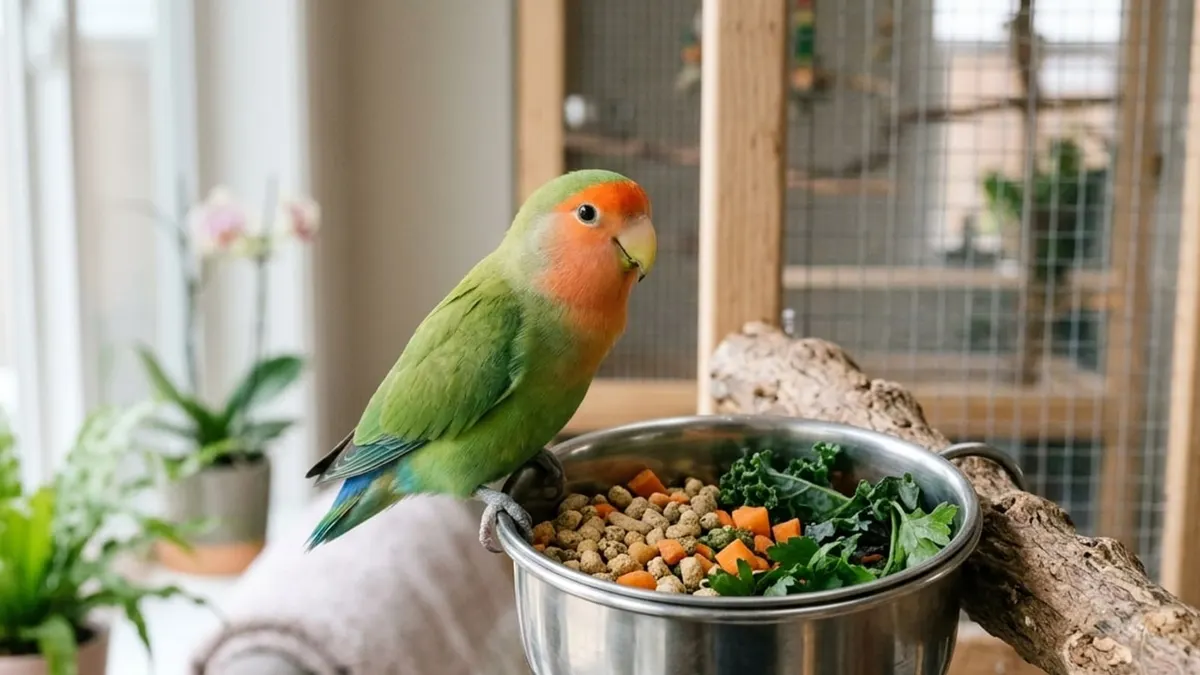
Best Lovebird Food (2026): Five Pellets and Blends Held to Vet Figures
Affiliate disclosure: product links on this page go to Amazon or to the maker's own store. As an Amazon Associate we earn from qualifying purchases, and VEVOR pays us a commission on sales through our VEVOR links, at no extra cost to you; links to other makers' stores earn us nothing. No retailer or brand sees our picks before they are published or has any say in them. How we choose.
The best lovebird food is a pellet the maker sizes for lovebirds, fed as most of the diet with vegetables on the side. VCA Animal Hospitals' avian vets put pellets at about 75% to 80% of a lovebird's diet and say lovebirds are vulnerable to vitamin A deficiency, low dietary calcium and egg-binding. Our top pick is ZuPreem True Harvest Medium: ZuPreem names lovebirds for this size, gives 1/8 to 1/4 cup a day as their serving, adds no colors and prints a vitamin D minimum of 500 IU/kg. The 10 lb bag was sold by Amazon itself when we checked on November 14, 2026.
For an organic pellet, Harrison's names lovebirds for both High Potency Fine (the first six months) and Adult Lifetime Fine, and publishes a full nutrient table for each. Every pick is sold by Amazon or the maker's own store, and every label was held to the Merck Veterinary Manual's figures.
Our top picks at a glance
- ZuPreem True Harvest, Medium (10 lb)
Lovebirds named: Yes, Medium size, 1/8 to 1/4 cup a day · Protein / fat (min): 14% / 4% (per the maker) · Calcium level: Not printed; calcium carbonate listed · Added colors: None
- Harrison's Adult Lifetime Fine (1 lb)
Lovebirds named: Yes, after 6 months on High Potency Fine · Protein / fat (min): 14% / 6% (per the maker) · Calcium level: 0.46% as fed (Harrison's data) · Added colors: None listed
- Harrison's Organic Premium Pellets, HOPP (1 lb)
Lovebirds named: On the Amazon listing; maker's page says small to medium birds · Protein / fat (min): 15% / 4.6% (per the maker) · Calcium level: 0.86% as fed (Harrison's data) · Added colors: Ingredient list not on the maker's page
4. Best for a lovebird that refuses pellets
Lafeber Pellet-Berries for Small Birds (2-pack)Lovebirds named: Yes (per the maker) · Protein / fat (min): 13% / 5% (per the maker) · Calcium level: Not printed; limestone and dicalcium phosphate listed · Added colors: None listed
- ZuPreem Smart Selects, Medium (2.5 lb)
Lovebirds named: Yes, Medium size, 1/8 to 1/4 cup a day · Protein / fat (min): 12% / 8%, fat 11.5% max (per the maker) · Calcium level: Not printed; calcium carbonate listed · Added colors: Yellow 5, Yellow 6, Red 40, Blue 1
| Pick | Lovebirds named | Protein / fat (min) | Calcium level | Added colors | Buy |
|---|---|---|---|---|---|
| ZuPreem True Harvest, Medium (10 lb)Best overall | Yes, Medium size, 1/8 to 1/4 cup a day | 14% / 4% (per the maker) | Not printed; calcium carbonate listed | None | Amazon |
| Harrison's Adult Lifetime Fine (1 lb)Best organic pellet | Yes, after 6 months on High Potency Fine | 14% / 6% (per the maker) | 0.46% as fed (Harrison's data) | None listed | Amazon |
| Harrison's Organic Premium Pellets, HOPP (1 lb)Best value organic pellet | On the Amazon listing; maker's page says small to medium birds | 15% / 4.6% (per the maker) | 0.86% as fed (Harrison's data) | Ingredient list not on the maker's page | Amazon |
| Lafeber Pellet-Berries for Small Birds (2-pack)Best for a lovebird that refuses pellets | Yes (per the maker) | 13% / 5% (per the maker) | Not printed; limestone and dicalcium phosphate listed | None listed | Amazon |
| ZuPreem Smart Selects, Medium (2.5 lb)Best seed blend | Yes, Medium size, 1/8 to 1/4 cup a day | 12% / 8%, fat 11.5% max (per the maker) | Not printed; calcium carbonate listed | Yellow 5, Yellow 6, Red 40, Blue 1 | Amazon |
Best overall
ZuPreem True Harvest, Medium (10 lb)
A dye-free pellet ZuPreem names for lovebirds, with a lovebird serving on the maker's page and a printed vitamin D minimum.
- Lovebirds named
- Yes, Medium size, 1/8 to 1/4 cup a day
- Protein / fat (min)
- 14% / 4% (per the maker)
- Calcium level
- Not printed; calcium carbonate listed
- Added colors
- None
Pros
- ZuPreem's page names lovebirds for the Medium size and gives 1/8 to 1/4 cup a day
- Vitamin D printed at 500 IU/kg minimum, with no added colors
- Sold by Amazon.com on November 14, 2026
Cons
- The 10 lb bag was the only Amazon-sold size; the 2.5 lb bag was out of stock
- Sugar is the eighth ingredient
- No calcium or vitamin A level on the label
ZuPreem True Harvest is ZuPreem's multigrain pellet with no color additives. ZuPreem's True Harvest page sizes the Medium for "Cockatiels, Quakers, Lovebirds, Small Conures" and gives them 1/8 to 1/4 cup a day. The guaranteed analysis is 14% protein minimum, 4% fat minimum, 5% fiber maximum and vitamin D 500 IU/kg minimum. A minimum is a floor, not the bag's actual fat.
Ground corn, soybean meal, millet, oat groats, barley and wheat come first, then sugar, vegetable oil, celery, carrots, parsley, beets, blueberries, cranberries and ground flaxseed. Calcium carbonate and dicalcium phosphate supply calcium, and vitamins A and D3 are added without a printed level.
The 2.5 lb bag was out of stock on November 14, 2026, so 10 lb is the size for now. ZuPreem FruitBlend Medium comes in 2 lb with the same protein and fat minimums, but adds fruit flavor and Yellow 5, Red 40, Yellow 6 and Blue 1.
Best organic pellet
Harrison's Adult Lifetime Fine (1 lb)
Harrison's names lovebirds for Adult Lifetime Fine and publishes every nutrient, with vitamin A inside Merck's range; start on High Potency Fine.
- Lovebirds named
- Yes, after 6 months on High Potency Fine
- Protein / fat (min)
- 14% / 6% (per the maker)
- Calcium level
- 0.46% as fed (Harrison's data)
- Added colors
- None listed
Pros
- Harrison's names lovebirds for both of its Fine formulas
- Its technical data puts vitamin A at 6,732 IU/kg, inside Merck's 5,000 to 8,000
- Certified organic; sold by Harrison's Bird Foods on Amazon
Cons
- Harrison's wants six months on High Potency first, so a second bag
- Harrison's says to use an opened bag within 12 weeks
- Peanut and sunflower kernels are in the recipe
Harrison's Adult Lifetime Fine is a certified organic maintenance food. Harrison's names lovebirds among the small to medium birds it suits, for healthy, non-breeding, non-molting birds after at least six months on a High Potency formula. The guaranteed analysis is 14% protein and 6% fat minimum. Harrison's technical data goes further than any other label here: as fed, 7.13% fat, 0.46% calcium, 0.38% phosphorus, vitamin A 6,732 IU/kg and vitamin D3 932 IU/kg.
Start a lovebird on High Potency Fine, which Harrison's lists for lovebirds and for every converting or breeding bird. It is richer: 18% protein and 12% fat minimum, and the data gives 13.14% fat, 0.70% calcium and vitamin A at 9,513 IU/kg as fed, above the 8,000 IU/kg ceiling Merck sets for pellets. Harrison's says to consult an avian vet before any diet change and every year after.
Whole corn, hull-less barley, hulled millet, toasted soybeans, peas and lentils lead the Adult Lifetime list, then peanut and sunflower kernels, oat groats, alfalfa, brown rice and chia.
Best value organic pellet
Harrison's Organic Premium Pellets, HOPP (1 lb)
Harrison's lower-priced organic pellet for small to medium birds, fed without a conversion stage, with the most calcium in Harrison's published data.
- Lovebirds named
- On the Amazon listing; maker's page says small to medium birds
- Protein / fat (min)
- 15% / 4.6% (per the maker)
- Calcium level
- 0.86% as fed (Harrison's data)
- Added colors
- Ingredient list not on the maker's page
Pros
- Calcium 0.86% and vitamin D3 1,660 IU/kg as fed in Harrison's data, the highest of the picks that publish them
- No High Potency stage first: fed as is, with fruit and vegetables at 20% of the diet
- Sold by Harrison's Bird Foods on Amazon in a 1 lb bag
Cons
- Lovebirds are named on Harrison's Amazon listing, not on its own product page
- The ingredient list was missing from Harrison's product page on November 14, 2026
Harrison's Organic Premium Pellets (HOPP) are a certified organic maintenance pellet for small to medium pet birds, and Harrison's store names lovebirds on the Amazon listing. Unlike Harrison's other formulas, HOPP needs no High Potency stage: Harrison's says to replace uneaten food daily, keep fresh fruits and vegetables to 20% of the diet, and add no vitamins or minerals. The guaranteed analysis is 15% protein and 4.6% fat minimum, with 5.5% fiber maximum.
Harrison's technical data gives HOPP the most calcium of its maintenance foods, 0.86% as fed against 0.46% for Adult Lifetime Fine, with vitamin A at 7,003 IU/kg (inside Merck's range) and vitamin D3 at 1,660 IU/kg. That matters most for a hen: VCA says single female lovebirds often become chronic egg layers, and every eggshell draws on her calcium. A food is not a treatment, so a hen that keeps laying still needs her vet.
The HOPP page showed no ingredient list on November 14, 2026; buy Adult Lifetime Fine to read every ingredient first.
Best for a lovebird that refuses pellets
Lafeber Pellet-Berries for Small Birds (2-pack)
Lafeber's round Pellet-Berries are 81% pellet bound with fruit and grains, sized by Lafeber for lovebirds to hold and pick apart.
- Lovebirds named
- Yes (per the maker)
- Protein / fat (min)
- 13% / 5% (per the maker)
- Calcium level
- Not printed; limestone and dicalcium phosphate listed
- Added colors
- None listed
Pros
- Lafeber names lovebirds and sizes the berries for small birds to hold and pull apart
- 81% pellet by Lafeber's own figure, the rest dried fruit and grains
- Sold by Lafeber Company on Amazon
Cons
- Maltodextrin and corn syrup are in the ingredient list
- Red millet and canary grass seed are part of the bind
- No daily amount on the Lafeber page we read
Lafeber's Pellet-Berries for Small Birds are its pellet formed into round berries with whole cranberries, dates, apricots and grains. Lafeber gives the split as 81% pellets and 19% fruits and grains, and says the berries are sized for cockatiels, lovebirds, conures, quakers and other small birds to hold and pull apart. Lafeber's lovebird care page says formulated diets are the best option because the bird cannot pick out only the bits it likes.
The guaranteed analysis is 13% protein and 5% fat minimum and 4.5% fiber maximum. Corn, soybean meal and dried fruit come first, then red millet, maltodextrin, wheat flour, hulled canary grass seed, canola oil and corn syrup; ground limestone and dicalcium phosphate supply calcium. We read this on Lafeber's own product page on November 14, 2026, where the bag is now 10 oz and sold direct; the page gives no daily amount.
Pellet-Berries are the pick for a seed eater that ignores plain pellets, as a full meal or as the step between seed and pellet. The page gave no daily amount, so weigh the bird weekly while switching.
Best seed blend
ZuPreem Smart Selects, Medium (2.5 lb)
A seed-and-pellet blend ZuPreem names for lovebirds, with a fat range inside Merck's 5% to 12%, for the seed share Merck allows small birds.
- Lovebirds named
- Yes, Medium size, 1/8 to 1/4 cup a day
- Protein / fat (min)
- 12% / 8%, fat 11.5% max (per the maker)
- Calcium level
- Not printed; calcium carbonate listed
- Added colors
- Yellow 5, Yellow 6, Red 40, Blue 1
Pros
- ZuPreem names lovebirds and gives 1/8 to 1/4 cup a day
- Prints a fat maximum of 11.5%, inside Merck's 5% to 12%, and lists no sunflower seed
- Sold by Amazon.com in a 2.5 lb bag on November 14, 2026
Cons
- Seed leads the recipe, and Merck says mixing seed and pellets invites picking
- Four artificial colors plus sulfur dioxide
- Vitamin D minimum is 300 IU/kg, against True Harvest's 500
Smart Selects is ZuPreem's seed blend with fortified pieces. ZuPreem's Smart Selects page names lovebirds for the Medium size at 1/8 to 1/4 cup a day. Proso millet, canary grass seed, oat groats, ground corn and safflower lead the ingredients, then soybean meal, shelled squash seeds, dried fruit, sugar and flaxseed, with calcium carbonate added. The analysis is 12% protein minimum, 8% to 11.5% fat, 9% fiber maximum and vitamin D 300 IU/kg minimum.
Smart Selects is here because the vets disagree. Merck puts lovebirds at 40% to 50% pellets plus 30% to 40% seed mix, while VCA wants seed kept to a very small part. If you follow Merck, a measured seed share belongs beside the pellet, but the same Merck chapter says a mixed bowl leads to selective eating, so we would serve the two in separate dishes.
Kaytee's Forti-Diet Pro Health Conure & Lovebird was left out: sunflower seed comes first, its 12% fat minimum is Merck's ceiling, and it lists FD&C colors too.
How we chose
We started from VCA Animal Hospitals' lovebird feeding page (updated February 25, 2025) and three Merck Veterinary Manual chapters. Every pick had to be a food whose maker names lovebirds or gives a size for them, with an analysis we read on the maker's own site, and it had to be sold either by Amazon itself or by its maker's own store on Amazon, never by a reseller. That rule left out three lovebird foods on November 14, 2026: Psittacus Minor (sold by Higgins Premium Pet Foods), TOP's Mini Parrot Pellets (sold by BirdDog Depot) and Lafeber's Premium Daily Cockatiel Pellets (sold by Happy Birds). Ratings and price were not reasons for any pick.
How much of a lovebird's diet should be pellets?
The sources split on lovebird pellets. VCA's lovebird page says the recommended diet is pellets at about 75% to 80%, with vegetables and a limited amount of fruit making up the rest, though its fruit section allows fruits, vegetables and greens at 20% to 40%. Merck's Management of Pet Birds chapter puts most small birds, lovebirds named, at 40% to 50% pellets and 30% to 40% seed mix.
| Source | Pellets | Seed | Vegetables and fruit | Also says |
|---|---|---|---|---|
| VCA (lovebirds) | About 75% to 80% | A very small part, never the majority | 20% to 25% (20% to 40% in its fruit section) | No grit; no supplements on a pellet diet |
| Merck (budgerigars, cockatiels, lovebirds) | 40% to 50% | 30% to 40% seed mix | 10% to 15% vegetables, 5% to 10% fruit | Mixed pellet and seed bowls lead to selective eating |
| Harrison's (Adult Lifetime) | 75% to 80% | None named | 15% to 20% | No vitamins unless a vet directs |
| Harrison's (HOPP) | The rest | None named | 20% | No added vitamins or minerals |
| Lafeber (lovebird page) | Formulated diet as the base | A seed-only diet is "a recipe for malnutrition" | Bird-safe vegetables and fruit for variety | Nutri-Berries and Avi-Cakes for foraging |
Every source rules out an all-seed diet. For the seeds people ask about most, see our chia, flax and sunflower seed guide.
Why calcium matters for a lovebird hen
VCA lists insufficient dietary calcium and egg-binding among the nutrition problems lovebirds are vulnerable to. Its chronic egg laying page says single female cockatiels, lovebirds, eclectus parrots and budgerigars often become chronic layers, that eggshells draw down calcium stores, and that birds on all-seed, calcium-deficient diets may not replace them fast enough. Merck adds that most seeds have a poor calcium to phosphorus ratio and that calcium deficiency can lead to egg binding.
Only Harrison's publishes calcium levels: 0.46% as fed in Adult Lifetime Fine, 0.70% in High Potency Fine and 0.86% in HOPP. ZuPreem and Lafeber list calcium carbonate, limestone or dicalcium phosphate without a level. VCA says egg laying can call for calcium supplementation, given under an avian vet's guidance.
The labels against Merck's figures
Merck's psittacine nutrition chapter has no lovebird row. Its adult maintenance protein for budgerigars and cockatiels (7% to 12%) is the nearest figure, and applying it to lovebirds is our inference. Its fat range (5% to 12%) and pellet vitamin A range (5,000 to 8,000 IU/kg) cover parrots in general. Protein is each maker's minimum; Harrison's as-fed data is in brackets.
| Food | Protein (min) | Fat | Vitamin A | Vitamin D | Calcium |
|---|---|---|---|---|---|
| Merck's figure | 7% to 12% (budgerigars, cockatiels) | 5% to 12% | 5,000 to 8,000 IU/kg | No lovebird figure | No figure given |
| ZuPreem True Harvest Medium | 14% | 4% min | Added, no level | 500 IU/kg min | Not printed |
| Harrison's Adult Lifetime Fine | 14% | 6% min (7.13%) | 6,732 IU/kg | 932 IU/kg | 0.46% |
| Harrison's High Potency Fine | 18% | 12% min (13.14%) | 9,513 IU/kg | 1,376 IU/kg | 0.70% |
| Harrison's HOPP | 15% | 4.6% min (5.93%) | 7,003 IU/kg | 1,660 IU/kg | 0.86% |
| Lafeber Pellet-Berries | 13% | 5% min | Added, no level | Added, no level | Not printed |
| ZuPreem Smart Selects Medium | 12% | 8% to 11.5% | Added, no level | 300 IU/kg min | Not printed |
Every protein minimum sits at or above the top of Merck's budgie and cockatiel range. Merck notes that protein needs rise for growing birds, laying hens and heavy molts, and that cockatiels without kidney disease tolerated far higher protein in a study. Vitamin D also comes from UVB light; see our full-spectrum and UVB bird light guide for an indoor bird.
How much to feed a lovebird
ZuPreem gives lovebirds 1/8 to 1/4 cup a day of True Harvest, FruitBlend or Smart Selects in the Medium size, and Kaytee gives 1/8 cup of its seed blend. Harrison's says birds may eat all they want and should be fed distinct meals to cut waste. VCA's lovebird care page puts an adult at 1.5 to 2 ounces (40 to 60 grams), and Merck says to weigh birds weekly. Separate dishes for pellets and fresh food are in our food and water dispenser guide.
Switching a lovebird from seed to pellets
VCA gives two schedules for lovebirds, starting with the dish a quarter full once a day. Option one: 75% seed and 25% pellets for 3 days, then half and half for 3 days, then 25% seed until the bird converts. Option two: 10 more points of pellets each day, from 90% seed on day one to none on day 10, holding at 20% seed if the bird balks. Merck's schedule is slower, starting at 20% pellets for about two weeks, then 30%, 50%, 75% and 100% two weeks apart. Merck says to call the vet if the bird loses more than 10% of its body weight, which is 4 to 6 grams for a 40 to 60 gram lovebird (our arithmetic).
VCA's tips: many lovebirds like to eat with their owners, so pretend to eat the pellets in front of the bird, or grind pellets onto a little moist food it already likes.
What to skip
- An all-seed diet, millet spray as a staple and honey sticks: VCA says seed mixes run high in fat, a lovebird often eats only one or two favorite seeds, and millet and honey sticks are nutrient-deficient.
- Grit: VCA and Merck both say parrots that hull their seeds do not need it, and VCA says some birds overeat it and block their gut.
- Vitamin powders on a pellet diet: VCA says a bird on 75% to 80% pellets generally needs none, and powder dusted on seed is wasted once the bird hulls it.
- Pale, watery vegetables such as iceberg lettuce and celery, which VCA says offer little nutrition.
- Avocado, onion, chocolate, caffeine and alcohol (VCA). Our list of foods poisonous to birds covers the rest.
For the cage these foods go into, see our lovebird cage guide.
Frequently asked questions
What is the best food for lovebirds?
A pellet sized for lovebirds, fed as most of the diet with vegetables and a little fruit. Our top pick is ZuPreem True Harvest Medium, which names lovebirds, adds no colors and gives 1/8 to 1/4 cup a day. Harrison's Adult Lifetime Fine is the organic choice, after six months on High Potency Fine.
Can lovebirds live on seeds only?
No. VCA says an all-seed diet can lead to ill health and a shorter life, and Merck says strictly seed diets are suboptimal even with supplements. Merck still allows small birds 30% to 40% seed mix beside pellets, while VCA wants seed kept to a very small part.
How much should a lovebird eat a day?
ZuPreem gives lovebirds 1/8 to 1/4 cup a day of its Medium pellets. VCA puts adult lovebirds at 40 to 60 grams, so weigh yours weekly on a gram scale, as Merck advises, and adjust. VCA says a thumbnail-sized portion of fresh food is a full plate for a lovebird.
What fruits and vegetables can lovebirds eat?
Dark, nutrient-dense ones: Harrison's names sweet potatoes, carrots, pumpkin, winter squash, broccoli, parsley, spinach, mango and papaya. VCA says to wash them, cut them small, serve them in a separate dish and remove them within a couple of hours. Skip iceberg lettuce and celery, and never feed avocado or onion.
Do lovebirds need grit or vitamin supplements?
Not grit: VCA and Merck both say parrots that hull their seeds do not need it. A lovebird eating 75% to 80% pellets generally needs no supplements either, per VCA, though an egg-laying hen may need calcium on an avian vet's advice.
What do lovebirds eat in the wild?
VCA says wild lovebirds eat grass seeds, fruits, berries and vegetation, varying with the season. Lafeber adds that they live in small flocks, and that the Abyssinian lovebird's diet includes native figs, which is why that species is rare in captivity.
Sources
- Lovebirds - Feeding, VCA Animal Hospitals (Gregory Rich, DVM; Laurie Hess, DVM; Rick Axelson, DVM)
- Chronic Egg Laying in Birds, VCA Animal Hospitals
- Nutrition in Psittacines, Merck Veterinary Manual (Joeke Nijboer, PhD; Anouk Fens, MSc)
- Management of Pet Birds, Merck Veterinary Manual (Sharman M. Hoppes, DVM)
- Nutritional Diseases of Pet Birds, Merck Veterinary Manual (Sharman M. Hoppes, DVM)
- Lovebird Personality, Food & Care, Lafeber Company (read from the Internet Archive copy of October 29, 2025)
- True Harvest, ZuPreem
- Smart Selects, ZuPreem
- Technical Data, Harrison's Bird Foods
- Harrison's Organic Premium Pellets, Harrison's Bird Foods
Cover image: Illustration: Bird Cage Review (AI-generated)
Related guides
What Do Cockatiels Eat? A Vet-Based Daily Diet for Cockatiels
The daily cockatiel diet from VCA and Merck: pellet, produce and seed shares, vitamin A foods, a cockatiel vitamin A study, hen calcium and toxic foods.
Best Finch and Canary Food (2026): Pellets, Seed and Egg Food Compared
Six finch and canary foods compared on the makers' own labels against VCA's and Merck's figures, with daily servings that differ by three times.
Can Birds Eat Chia, Flax and Sunflower Seeds? What Vet Sources Say
Chia, flax and sunflower seeds compared on fat, calcium and omega-3 from USDA data, with Merck and VCA on how much a pet bird should get.