
Bird Cage Size Guide by Species: The Veterinary Minimums, Side by Side
Affiliate disclosure: product links on this page go to Amazon, or to the maker's own store for brands that sell only direct. As an Amazon Associate we earn from qualifying purchases, at no extra cost to you; a link to a maker's store earns us nothing. No retailer or brand sees our picks before they are published or has any say in them. How we choose.
Two veterinary sources publish minimum cage sizes by species, and they do not quite agree, so this guide shows both. The Merck Veterinary Manual's table gives 20 by 20 by 30 inches for budgies, cockatiels, lovebirds and parrotlets, 36 by 24 by 48 for conures and their size class, 40 by 30 by 60 for African greys, Amazons and small cockatoos, and 48 by 36 by 66 for macaws and large cockatoos. VCA Animal Hospitals gives 1 by 1 by 2 feet for finches, canaries and budgies, 2 by 2 by 3 feet for cockatiels, lovebirds and parrotlets, 3 by 3 by 3 feet for conures, caiques and Senegals, 3 by 3 by 4 feet for greys and Amazons, and 4 by 5 by 5 feet for large macaws. Both say the same thing above the table: buy the largest cage you can. The size checker runs any cage against these numbers; the four cages below are the ones our species guides keep coming back to: the Prevue F050 flight cage for small birds, the Yaheetech 60.5-inch flight cage for cockatiels and small conures, the Flyline corner aviary for greys and Amazons and the Prevue Empire for macaws.
Our top picks at a glance
1. Small birds
Prevue Flight Cage F050 (37 x 23 x 60 in, 1/2 in spacing)Interior: 36 1/8 x 22 1/8 x 47 in (Prevue) · Bar spacing: 1/2 in; 8 and 12 gauge wire (Prevue) · Meets Merck for: Budgie, cockatiel, lovebird, parrotlet (20 x 20 x 30, 0.5 in); below the conure row's 24 in width
2. Cockatiels and small conures
Yaheetech 60 in Flight Cage with Stand (37 x 22.5 x 44.5 in cage, 5/8 in spacing)Interior: 37 x 22.5 x 44.5 in (per the Amazon listing) · Bar spacing: 5/8 in (per the Amazon listing) · Meets Merck for: Budgie through cockatiel row (20 x 20 x 30 at 0.5 in: spacing is 1/8 in wider than Merck's small-bird figure); conure row needs 24 in deep and 48 in tall
3. Greys and Amazons
Flyline Corner Bird Cage, extra large (51.2 x 51.2 x 73 in, 3/4 in spacing)Interior: Not stated; 51.2 x 51.2 x 73 in overall with seed skirt (per the Amazon listing) · Bar spacing: 3/4 in; 1/8 in bar gauge (per the Amazon listing) · Meets Merck for: African grey, Amazon, small cockatoo (40 x 30 x 60, 0.75 in), by the overall figures; interior not stated
4. Macaws
Prevue Empire Bird Cage 3157 (45 3/8 x 35 3/8 x 63 in interior, 1 3/8 in spacing, 9 gauge)Interior: 45 3/8 x 35 3/8 x 63 in; about 10 in more with the floor grille removed (Prevue) · Bar spacing: 1 3/8 in; 9 gauge (Prevue) · Meets Merck for: Just under the macaw row (48 x 36 x 66) by 2 5/8, 5/8 and 3 in; well over VCA's small-macaw 36 x 36 x 48
| Pick | Interior | Bar spacing | Meets Merck for | Buy |
|---|---|---|---|---|
| Prevue Flight Cage F050 (37 x 23 x 60 in, 1/2 in spacing)Small birds | 36 1/8 x 22 1/8 x 47 in (Prevue) | 1/2 in; 8 and 12 gauge wire (Prevue) | Budgie, cockatiel, lovebird, parrotlet (20 x 20 x 30, 0.5 in); below the conure row's 24 in width | Amazon |
| Yaheetech 60 in Flight Cage with Stand (37 x 22.5 x 44.5 in cage, 5/8 in spacing)Cockatiels and small conures | 37 x 22.5 x 44.5 in (per the Amazon listing) | 5/8 in (per the Amazon listing) | Budgie through cockatiel row (20 x 20 x 30 at 0.5 in: spacing is 1/8 in wider than Merck's small-bird figure); conure row needs 24 in deep and 48 in tall | Amazon |
| Flyline Corner Bird Cage, extra large (51.2 x 51.2 x 73 in, 3/4 in spacing)Greys and Amazons | Not stated; 51.2 x 51.2 x 73 in overall with seed skirt (per the Amazon listing) | 3/4 in; 1/8 in bar gauge (per the Amazon listing) | African grey, Amazon, small cockatoo (40 x 30 x 60, 0.75 in), by the overall figures; interior not stated | Amazon |
| Prevue Empire Bird Cage 3157 (45 3/8 x 35 3/8 x 63 in interior, 1 3/8 in spacing, 9 gauge)Macaws | 45 3/8 x 35 3/8 x 63 in; about 10 in more with the floor grille removed (Prevue) | 1 3/8 in; 9 gauge (Prevue) | Just under the macaw row (48 x 36 x 66) by 2 5/8, 5/8 and 3 in; well over VCA's small-macaw 36 x 36 x 48 | Prevue Pet Products |
Small birds
Prevue Flight Cage F050 (37 x 23 x 60 in, 1/2 in spacing)
Prevue's F050 flight cage: 36 1/8 by 22 1/8 by 47 inches inside with 1/2-inch bars, which clears the Merck 20 by 20 by 30 minimum for budgies, cockatiels, lovebirds and parrotlets.
- Interior
- 36 1/8 x 22 1/8 x 47 in (Prevue)
- Bar spacing
- 1/2 in; 8 and 12 gauge wire (Prevue)
- Meets Merck for
- Budgie, cockatiel, lovebird, parrotlet (20 x 20 x 30, 0.5 in); below the conure row's 24 in width
- Overall
- 37 x 23 x 60 in on its caster stand (Prevue)
Pros
- Wider than it is tall inside, which is the shape VCA and RSPCA ask for
- 1/2-inch spacing is the Merck figure for the small-bird row
- Six side doors and two front doors
Cons
- 22 1/8 in deep: below VCA's 24-inch depth for cockatiels
- Sold direct and through retailers; not on Amazon when we looked
- Plastic tray
Prevue lists the F050 at 37 by 23 by 60 inches overall and 36 1/8 by 22 1/8 by 47 inside, with 1/2-inch wire spacing in 8 and 12 gauge powder-coated steel, for canaries, parakeets and other small to medium birds. Against Merck's table it clears the first row with room to spare; against VCA's 2 by 2 by 3 feet for cockatiels it is 2 inches short in depth and well over in length and height. It is the cage in our flight cage guide and parakeet guide.
Cockatiels and small conures
Yaheetech 60 in Flight Cage with Stand (37 x 22.5 x 44.5 in cage, 5/8 in spacing)
37 by 22.5 by 44.5 inches with 5/8-inch bars: over Merck's small-bird row, just under its conure row, and the widest cage under $200 we found.
- Interior
- 37 x 22.5 x 44.5 in (per the Amazon listing)
- Bar spacing
- 5/8 in (per the Amazon listing)
- Meets Merck for
- Budgie through cockatiel row (20 x 20 x 30 at 0.5 in: spacing is 1/8 in wider than Merck's small-bird figure); conure row needs 24 in deep and 48 in tall
- Overall
- 37 x 22.5 x 60.5 in on wheels; 49.4 lb (per the Amazon listing)
Pros
- 37 inches of flight length
- Two full-width front doors
- Under $190
Cons
- 5/8-inch bars are wider than Merck's 0.5 for budgies and lovebirds (the listing names them anyway)
- 1.5 in short of the conure row's depth
- Listing figures only
Yaheetech's 60.5-inch flight cage is listed at 37 by 22.5 by 44.5 inches with 5/8-inch bar spacing, four dowel perches and four feeders, for 10 to 12 small or medium birds by the seller's count. The honest reading: it is a cockatiel or small-conure cage by the bar spacing (Merck's 0.5 for the smallest birds is narrower), and it is 1.5 inches shallower and 3.5 inches shorter than Merck's conure row. The cockatiel guide has it beside the alternatives.
Greys and Amazons
Flyline Corner Bird Cage, extra large (51.2 x 51.2 x 73 in, 3/4 in spacing)
A corner aviary 51 by 51 inches with the seed skirt and 73 inches tall, 3/4-inch spacing and 1/8-inch bars: the one cage we found that clears Merck's grey and Amazon row at 3/4-inch spacing.
- Interior
- Not stated; 51.2 x 51.2 x 73 in overall with seed skirt (per the Amazon listing)
- Bar spacing
- 3/4 in; 1/8 in bar gauge (per the Amazon listing)
- Meets Merck for
- African grey, Amazon, small cockatoo (40 x 30 x 60, 0.75 in), by the overall figures; interior not stated
- Overall
- 51.2 x 51.2 x 73 in; 150 lb (per the Amazon listing)
Pros
- 3/4-inch spacing matches Merck's row for greys and Amazons
- Corner footprint
- Opening top
Cons
- $760
- Interior dimensions not stated; the skirt is in the overall figure
- 150 lb, ships freight
Flyline's Parrot Escape Jumbo Corner (X-Large) is listed at 73 inches tall and 51.2 inches on each side including the seed skirt, with 3/4-inch bar spacing and 1/8-inch bars, two wood perches, four swing feeder gates and an opening top. The listing gives no interior figure, so the margin over Merck's 40 by 30 by 60 is the skirt's width, which we cannot subtract exactly; a corner cage's interior is also a triangle, so treat the 51-inch sides as the long dimensions. The African grey guide compares it with the stainless and walk-in options.
Macaws
Prevue Empire Bird Cage 3157 (45 3/8 x 35 3/8 x 63 in interior, 1 3/8 in spacing, 9 gauge)
Prevue's Empire: 45 3/8 by 35 3/8 by 63 inches inside with 1 3/8-inch spacing in 9-gauge wire, within 3 inches of Merck's macaw row on every side.
- Interior
- 45 3/8 x 35 3/8 x 63 in; about 10 in more with the floor grille removed (Prevue)
- Bar spacing
- 1 3/8 in; 9 gauge (Prevue)
- Meets Merck for
- Just under the macaw row (48 x 36 x 66) by 2 5/8, 5/8 and 3 in; well over VCA's small-macaw 36 x 36 x 48
- Overall
- 46 x 36 x 78 1/4 in; 54 1/4 x 44 3/8 in with seed guard (Prevue)
Pros
- Prevue publishes every dimension
- 9-gauge wire and flathead hex bolts a beak cannot undo
- Removing the grille gives about 10 in more height (Prevue)
Cons
- Short of Merck's 48 x 36 x 66 on all three sides
- 1 3/8 in spacing is narrower than Merck's 1.5 but wider than the 1 in some retailers give for greys
- Sold direct and through dealers
Prevue's Empire (3157) is 46 by 36 by 78 1/4 inches overall and 45 3/8 by 35 3/8 by 63 inside, 1 3/8-inch spacing, 9-gauge wire, one 20 by 43 inch door, a 1 1/8-inch hardwood perch and three stainless cups, and Prevue calls it a macaw cage. It is the closest thing to Merck's macaw minimum from a maker that states its interior; the macaw guide puts it beside the A&E walk-in aviary and the Seny double cage.
The two tables
Merck's table is labelled length by width by height in inches. VCA's figures are given in feet (and centimetres) in the same order on its small-bird and large-bird housing pages. Where they differ, the larger figure is the one to aim for; both sources say bigger is better and give these as floors.
| Bird | Merck Veterinary Manual (L x W x H, in) | Merck bar spacing | VCA Animal Hospitals (L x W x H) |
|---|---|---|---|
| Finch, canary | Not listed | Not listed | 1 x 1 x 2 ft (12 x 12 x 24 in) |
| Budgie (parakeet) | 20 x 20 x 30 | 0.5 in | 1 x 1 x 2 ft |
| Cockatiel, lovebird, parrotlet | 20 x 20 x 30 | 0.5 in | 2 x 2 x 3 ft (24 x 24 x 36 in) |
| Conure, Poicephalus (Senegal), caique, mini macaw | 36 x 24 x 48 | 0.75 in | 3 x 3 x 3 ft (36 x 36 x 36 in) |
| African grey, Amazon | 40 x 30 x 60 | 0.75 in (the table prints "0.751"; we read the trailing 1 as a footnote mark, an inference) | 3 x 3 x 4 ft (36 x 36 x 48 in) |
| Small cockatoo | 40 x 30 x 60 | 0.75 in | 2 x 3 x 4 ft (24 x 36 x 48 in) |
| Small macaw (Severe, Hahn's, Yellow-collared) | 36 x 24 x 48 (mini macaw row) | 0.75 in | 3 x 3 x 4 ft |
| Large macaw, large cockatoo | 48 x 36 x 66 | 1.5 in | 4 x 5 x 5 ft (48 x 60 x 60 in) for large macaws; 4 x 4 x 4 ft for large cockatoos |
The wingspan rules
The tables come from rules of thumb that the sources also state. Merck's owner page: the cage should be at least one and a half times the bird's wingspan in all directions. The MSPCA, citing the Association of Avian Veterinarians' chart: 1.5 to 2 times the wingspan in all directions, with both wings spread touching no bar, the bird able to turn on a perch without its tail touching, and able to fly from bottom to top without touching. RSPCA Australia, for pairs: a length of at least three times the pair's combined wingspan, at least two wing beats between perches, and a height of at least three times the largest bird's head-to-tail length. PetMD's Dr. Patricia Latas: floor space no less than 18 by 18 inches per bird, 24 by 30 for medium birds, and a cage longer than it is tall because birds fly side to side.
Length beats height
VCA: the cage should be about as long as it is tall, and tall narrow cages are discouraged because birds move side to side. RSPCA: most birds do better in a cage that is longer rather than high. That is why a 62-inch "large" cage that is 17 inches wide fails every table above, and why flight cages (wide, not tall) are the small-bird answer in all of our species guides.
How to measure a cage
- Use the maker's interior figure, not the overall height with the stand or play top. Prevue publishes both; most Amazon listings give only the overall size and sometimes the cage size in a bullet.
- Subtract the play top, the stand and the seed skirt from the overall height and width. A 68-inch play-top cage is often a 35-inch cage on a 20-inch stand.
- Compare length, width and height against the row above, and the bar spacing against Merck's figure.
- Check the shape: longer than tall, rectangular (VCA and Merck both prefer rectangular to round; VCA says round cages leave lower perches soiled).
The size checker does the comparison; the bar spacing guide covers the second number.
Where the tables fall short
Neither table covers finches and canaries beyond VCA's 1 by 1 by 2 feet for one bird, and neither covers pairs or flocks except by the rules of thumb; the RSPCA's three-wingspans rule is the one for pairs. Neither gives a figure for Quakers, ringnecks or cockatoos smaller than "small cockatoo". (Before buying a Quaker, check our Quaker parrot laws by state; twelve states ban them as pets.) Where a bird is not listed, use the row for the next larger bird and the wingspan rules.
What the minimum does not buy
Merck's overview links small cages and little exercise to physical and psychological problems, and RSPCA says most cages are too small for flight and birds should have flight time outside them. A cage that meets the row above is a bedroom, not a life; the play stand guide and placement guide cover the rest of the room.
Frequently asked questions
What is the minimum cage size for a cockatiel?
Merck's table gives 20 by 20 by 30 inches with 0.5-inch bar spacing; VCA Animal Hospitals gives 2 by 2 by 3 feet (24 by 24 by 36 inches). Both say to buy the largest cage you can; aim for the VCA figure or larger.
What size cage does a budgie need?
Merck: 20 by 20 by 30 inches with 0.5-inch bars. VCA: 1 by 1 by 2 feet. A flight cage 30 inches or longer with 1/2-inch bars (Prevue's F040 or F050) clears both with room to fly.
What size cage does an African grey need?
Merck: 40 by 30 by 60 inches with 0.75-inch bars; VCA: 3 by 3 by 4 feet. Few cages under $500 reach either; our African grey guide shows which do.
What size cage does a macaw need?
Merck: 48 by 36 by 66 inches with 1.5-inch bars for large macaws and cockatoos; VCA: 4 by 5 by 5 feet for large macaws and 3 by 3 by 4 feet for small macaws. Prevue's Empire (45 by 35 by 63 inside) is the closest maker-stated cage we found.
Is it better for a bird cage to be wide or tall?
Wide. VCA says the cage should be about as long as it is tall and discourages tall narrow cages; RSPCA says birds fly horizontally and do better in longer cages. Measure the length first.
Do I measure the cage or the whole stand?
The cage interior. Makers like Prevue publish both; many listings give an overall height that includes a 15 to 20 inch stand and a play top. Subtract them before comparing with the table.
Sources
- Minimum and Bar Spacing Recommendations (table), Merck Veterinary Manual
- Overview of Pet Birds, Merck Veterinary Manual
- Providing a Home for a Pet Bird, Merck Veterinary Manual (pet owner version)
- Housing Small Birds, VCA Animal Hospitals
- Housing Large Birds, VCA Animal Hospitals
- Suggestions for Housing Birds, MSPCA-Angell
- How to help your pet bird have a good life, RSPCA Australia
- How to Set Up the Perfect Bird Cage, PetMD (Dr. Patricia Latas, DVM)
- Large Flight Bird Cage F050, Prevue Pet Products
- Empire Large Bird Cage 3157, Prevue Pet Products
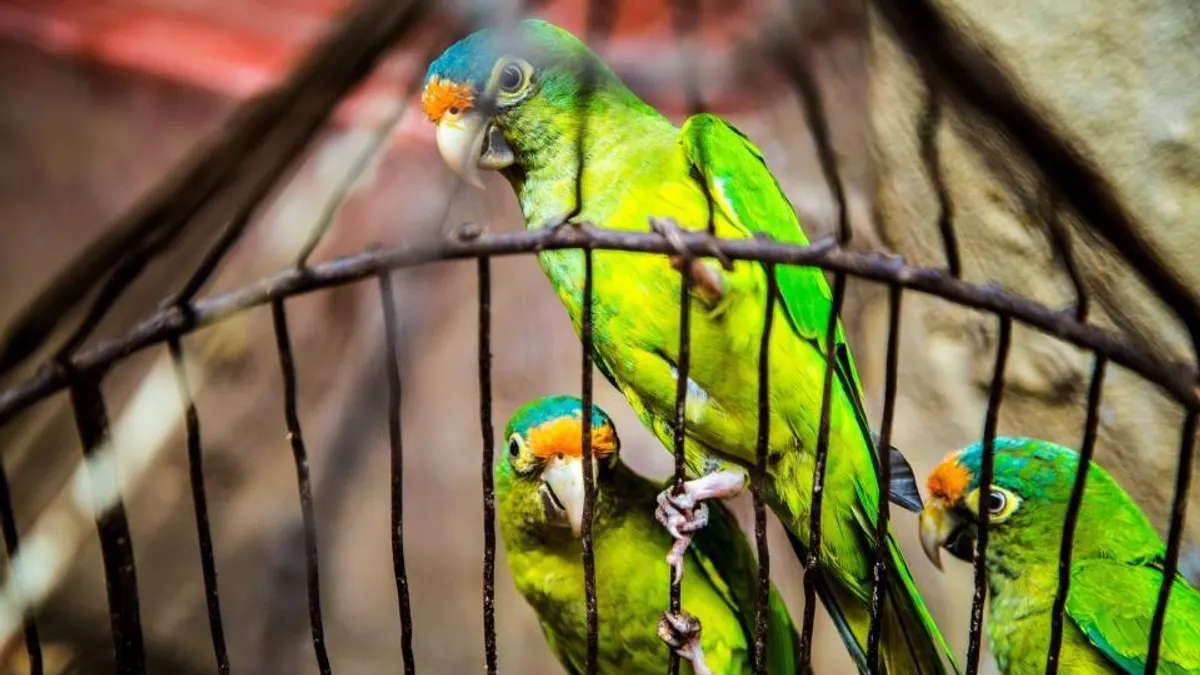
Cover photo: Green Birds by Hermes Rivera, CC0 1.0, via StockSnap. Cropped.
Related guides
Bird Cage Bar Spacing Guide: The Right Gap for Every Species, and Why
The Merck bar-spacing figures by species, the finger test, why gauge matters as much as gap for big birds, and cages that match each figure.
Bird Cage Buying Guide: Size, Spacing, Material, Doors, Tray and Price, in Order
The checks in order before buying any cage: species minimum, spacing and gauge, material, shape, doors, tray, stand, the listing's traps and the price by size class.
Bird Cage Cleaning and Disinfecting Guide: Daily, Weekly and the Full Sequence
The daily routine from VCA and PetMD, the CDFA's six-step deep clean with label-only disinfecting, and the products and fumes to keep out of a bird room.