
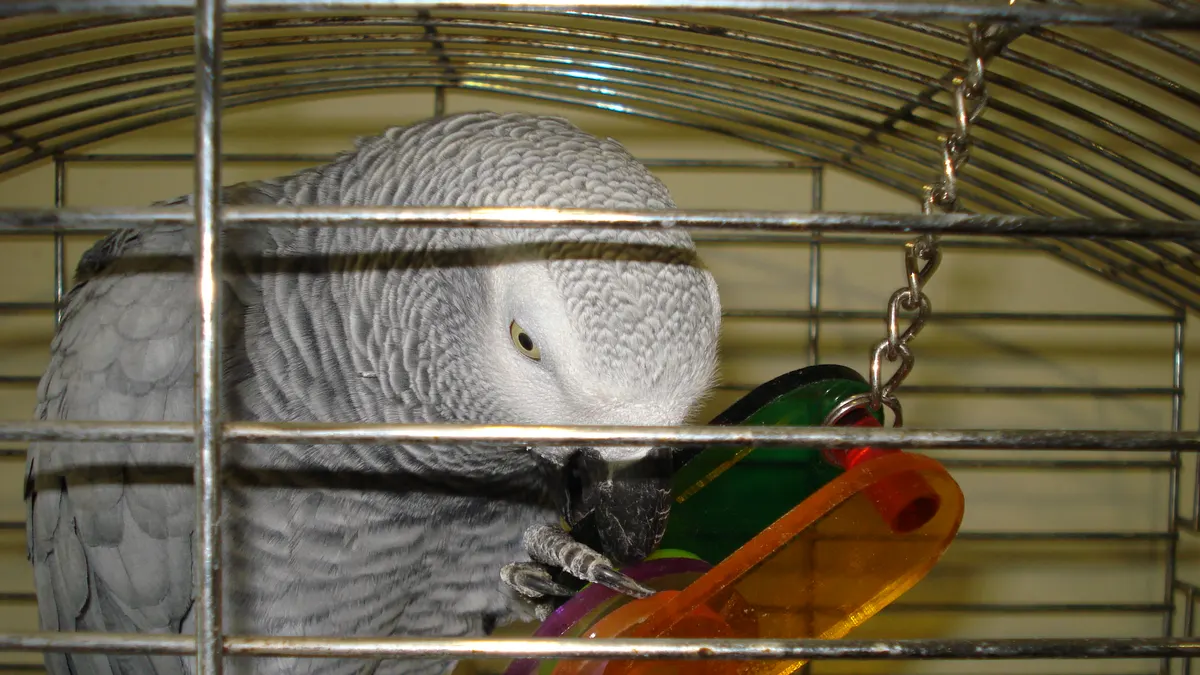
Best Bird Toys for Parrots (2026), Matched to Your Bird's Size
Affiliate disclosure: product links on this page go to Amazon, or to the maker's own store for brands that sell only direct. As an Amazon Associate we earn from qualifying purchases, at no extra cost to you; a link to a maker's store earns us nothing. No retailer or brand sees our picks before they are published or has any say in them. How we choose.
The right toy is the one sized to the beak. Lafeber's veterinary client handout on toy safety puts it first: toys must be appropriate to the bird's size, small removable parts are the main hazard, and plastic beads are fine for small birds but should never go to large ones. For budgies, parrotlets, lovebirds and cockatiels, the Super Bird Creations Balsa Stack (soft balsa slats, sized by the maker for small birds) is the first toy to hang, with Bonka's sola balls as foot toys and Bonka's French Fries as the foraging toy. For conures and ringnecks, the Super Bird Creations PVC Forager is the treat hider. For greys, Amazons, cockatoos and macaws, the Planet Pleasures 14-inch Spiked Pinata is the all-natural shredder and the Creative Foraging Systems Foraging Wheel is the puzzle for a bird that eats its toys.
Every pick is judged on the maker's stated bird size and materials against the handout's rules for wood, beads, bells, rope and connectors, and the table under the picks lays those rules out by bird size so you can check any toy in the store the same way.
Our top picks at a glance
1. Best chew toy for small birds
Super Bird Creations SB680 Balsa Stack (small birds)Bird size: Small: parrotlets, parakeets, cockatiels, lovebirds (per the Amazon listing) · Material: Four balsa slats separated by plastic beads (per the Amazon listing) · Play type: Chew (destructible) · Size: 6.5 x 2 in (per the Amazon listing)
2. Best foot toy
Bonka 1214 Sola Atta Balls, 3-packBird size: Small and medium birds (per the Amazon listing) · Material: Pith of the sola plant, Aeschynomene aspera (per the Amazon listing) · Play type: Foot toy, shredding · Size: About 2.25 to 2.5 in across, three per pack (per the Amazon listing)
3. Best foraging toy for small and medium birds
Bonka 2306 French Fries foraging toyBird size: Cockatiels, parakeets, conures and similar (per the maker) · Material: Bamboo finger traps, crinkle paper (per the maker) · Play type: Foraging, shredding · Size: About 9.5 x 5 in, about 3 oz (per the Amazon listing)
4. Best shredding toy for small birds
Planet Pleasures Pineapple Foraging Toy, SmallBird size: Four sizes; the Small fits small birds · Material: Palm and sisal (per the Amazon listing) · Play type: Shredding, preening, foraging · Size: Small 5 x 2 x 2 in; Medium 7 x 2.5 x 2.5; Large 9 x 3 x 3; XL 11 x 4 x 4 (per the maker)
5. Best treat hider for medium birds
Super Bird Creations SB751 PVC Forager (medium to large birds)Bird size: Ringnecks, medium conures, Quakers, caiques, pionus, Senegals up to mini macaws (per the Amazon listing) · Material: Drinking-water-grade PVC, plastic beads (per the Amazon listing) · Play type: Foraging (non-destructible) · Size: 3 x 5 x 8 in (per the Amazon listing)
6. Best shredding toy for large birds
Planet Pleasures Spiked Pinata, Large (14 in)Bird size: Large parrots (sized at 14 in) · Material: Palm leaves with natural stuffing (per the Amazon listing) · Play type: Shredding, foraging · Size: 14 in (per the Amazon listing)
7. Best puzzle for birds that eat their toys
Creative Foraging Systems Foraging Wheel Gen II, Extra LargeBird size: Medium and large birds (per the maker); Gen II XL listed for large birds · Material: Polycarbonate, dishwasher safe (per the Amazon listing) · Play type: Puzzle, foraging (non-destructible) · Size: 7 x 4 x 9 in, six compartments (per the Amazon listing)
| Pick | Bird size | Material | Play type | Size | Buy |
|---|---|---|---|---|---|
| Super Bird Creations SB680 Balsa Stack (small birds)Best chew toy for small birds | Small: parrotlets, parakeets, cockatiels, lovebirds (per the Amazon listing) | Four balsa slats separated by plastic beads (per the Amazon listing) | Chew (destructible) | 6.5 x 2 in (per the Amazon listing) | Amazon |
| Bonka 1214 Sola Atta Balls, 3-packBest foot toy | Small and medium birds (per the Amazon listing) | Pith of the sola plant, Aeschynomene aspera (per the Amazon listing) | Foot toy, shredding | About 2.25 to 2.5 in across, three per pack (per the Amazon listing) | Amazon |
| Bonka 2306 French Fries foraging toyBest foraging toy for small and medium birds | Cockatiels, parakeets, conures and similar (per the maker) | Bamboo finger traps, crinkle paper (per the maker) | Foraging, shredding | About 9.5 x 5 in, about 3 oz (per the Amazon listing) | Amazon |
| Planet Pleasures Pineapple Foraging Toy, SmallBest shredding toy for small birds | Four sizes; the Small fits small birds | Palm and sisal (per the Amazon listing) | Shredding, preening, foraging | Small 5 x 2 x 2 in; Medium 7 x 2.5 x 2.5; Large 9 x 3 x 3; XL 11 x 4 x 4 (per the maker) | Amazon |
| Super Bird Creations SB751 PVC Forager (medium to large birds)Best treat hider for medium birds | Ringnecks, medium conures, Quakers, caiques, pionus, Senegals up to mini macaws (per the Amazon listing) | Drinking-water-grade PVC, plastic beads (per the Amazon listing) | Foraging (non-destructible) | 3 x 5 x 8 in (per the Amazon listing) | Amazon |
| Planet Pleasures Spiked Pinata, Large (14 in)Best shredding toy for large birds | Large parrots (sized at 14 in) | Palm leaves with natural stuffing (per the Amazon listing) | Shredding, foraging | 14 in (per the Amazon listing) | Amazon |
| Creative Foraging Systems Foraging Wheel Gen II, Extra LargeBest puzzle for birds that eat their toys | Medium and large birds (per the maker); Gen II XL listed for large birds | Polycarbonate, dishwasher safe (per the Amazon listing) | Puzzle, foraging (non-destructible) | 7 x 4 x 9 in, six compartments (per the Amazon listing) | Amazon |
Best chew toy for small birds
Super Bird Creations SB680 Balsa Stack (small birds)
Soft balsa a budgie or cockatiel can actually destroy, sized by its maker for parrotlets to lovebirds.
- Bird size
- Small: parrotlets, parakeets, cockatiels, lovebirds (per the Amazon listing)
- Material
- Four balsa slats separated by plastic beads (per the Amazon listing)
- Play type
- Chew (destructible)
- Size
- 6.5 x 2 in (per the Amazon listing)
Pros
- Balsa is one of the softest woods, so small beaks make progress
- Plastic beads are the bead the handout allows for small birds
- Sold by Amazon.com
Cons
- A cockatiel can finish it fast, so it is a consumable
- Too small and too soft for a conure or larger
- Specs only from the listing; the maker's own site did not load
Lafeber's toy chapter (an excerpt from D'Arezzo and Shannon-Nunn's book) says every parrot from a budgie up must have wood it can chew, and that small birds need smaller pieces of softer wood, naming pine and cholla, because hardwoods such as manzanita are too tough for them to destroy. The Balsa Stack is four balsa slats on a stack with plastic beads between, listed for parrotlets, parakeets, cockatiels and lovebirds.
A toy that a small bird cannot dent is a toy it ignores, which is why this is the first pick and the hardwood blocks sold as "for all birds" are not. Expect to replace it: destroying it is the job. Skip it for anything conure-sized and up; those birds are what the PVC Forager and the pinata below are for.
Best foot toy
Bonka 1214 Sola Atta Balls, 3-pack
Three light sola balls a small or medium bird can grab, carry, toss and shred, with no hardware at all.
- Bird size
- Small and medium birds (per the Amazon listing)
- Material
- Pith of the sola plant, Aeschynomene aspera (per the Amazon listing)
- Play type
- Foot toy, shredding
- Size
- About 2.25 to 2.5 in across, three per pack (per the Amazon listing)
Pros
- No chain, clip or bell to worry about
- Soft enough for a budgie to shred
- Doubles as toy parts for homemade toys
Cons
- Natural material, so sizes vary slightly
- A large parrot will flatten one in minutes
- Will not hang without a skewer or toy part
The handout's four toy types are climbing, foot, chew and puzzle toys, and foot toys are the ones most cages lack. Lafeber's chapter describes them as small toys a bird can grasp in its foot, and suggests a toy bowl in the cage so the bird can pick its own. These are balls of sola pith, the soft spongy stem of the sola plant, listed at about 2.25 to 2.5 inches across.
With nothing metal on them, they are the simplest toy here to judge. Put two in a spare dish and keep one back to swap in later. For a large parrot, a whole walnut-sized nut or a hardwood foot toy lasts longer; sola is for small and medium beaks.
Best foraging toy for small and medium birds
Bonka 2306 French Fries foraging toy
Bamboo finger traps in a cup to stuff with treats, made in the USA for cockatiels, parakeets and conures.
- Bird size
- Cockatiels, parakeets, conures and similar (per the maker)
- Material
- Bamboo finger traps, crinkle paper (per the maker)
- Play type
- Foraging, shredding
- Size
- About 9.5 x 5 in, about 3 oz (per the Amazon listing)
Pros
- Refillable: stuff the traps again with paper and treats
- Quick link included, the connector the handout suggests for most birds
- Made in the USA, per the maker
Cons
- The cup's material is not named by the maker
- Paper and bamboo are gone quickly with a strong chewer
- Hangs on a chain, so check the links as you would any toy
Lafeber's chapter calls foraging the activity that occupies most of a wild parrot's day, and its parakeet article says budgies benefit from foraging for at least some of their food. Bonka's French Fries is a cup of bamboo finger traps over crinkle paper; Bonka lists it for cockatiels, parakeets, conures and similar birds and says it comes with a quick link.
Start easy: leave a seed or treat visible at the end of a trap so the bird learns there is food inside, then tuck it deeper. If a treat other than seed or nuts goes in, the chapter's advice is to take it out before it spoils.
Best shredding toy for small birds
Planet Pleasures Pineapple Foraging Toy, Small
Woven palm and sisal to climb, shred and preen, in four sizes so the same toy fits a lovebird or a grey.
- Bird size
- Four sizes; the Small fits small birds
- Material
- Palm and sisal (per the Amazon listing)
- Play type
- Shredding, preening, foraging
- Size
- Small 5 x 2 x 2 in; Medium 7 x 2.5 x 2.5; Large 9 x 3 x 3; XL 11 x 4 x 4 (per the maker)
Pros
- All natural fibers
- Treats can be hidden inside
- Same toy in four sizes as the bird or flock grows
Cons
- Planet Pleasures does not say which size suits which species
- Fibers wear loose, so check it daily
- Made in the Philippines (per the Amazon listing); dyes are not described by the maker
Shredding is its own need: the chapter's "Preener" category covers toys a bird can preen, shred and weave, and says they are best hung near the roosting perch. Planet Pleasures' pineapple is woven palm and sisal (per the Amazon listing), and the maker's size chart runs from 5 x 2 x 2 inches to 11 x 4 x 4 inches.
The maker gives no species per size, so size it to the bird: the Small for budgies and lovebirds, Medium for cockatiels and small conures, Large and XL for bigger birds. The handout's rule for natural fiber applies here: remove it once it is soiled or frayed, and watch that the bird shreds it rather than eats it.
Best treat hider for medium birds
Super Bird Creations SB751 PVC Forager (medium to large birds)
A dishwasher-safe PVC pipe to stuff with treats, for ringnecks, conures and Quakers that need to work for food.
- Bird size
- Ringnecks, medium conures, Quakers, caiques, pionus, Senegals up to mini macaws (per the Amazon listing)
- Material
- Drinking-water-grade PVC, plastic beads (per the Amazon listing)
- Play type
- Foraging (non-destructible)
- Size
- 3 x 5 x 8 in (per the Amazon listing)
Pros
- Dishwasher safe (per the Amazon listing)
- Lasts: the pipe is not meant to be eaten
- Easy to refill with paper and treats
Cons
- Plastic beads: the handout says never for large birds
- Listed for greys and Amazons, which we would not follow with the beads on
- Specs only from the listing
Super Bird Creations lists the PVC Forager for birds from ringnecks and medium conures up to greys, Amazons, eclectus, small cockatoos and mini macaws. It is a drinking-water-grade PVC pipe with plastic beads, and the listing says it is dishwasher safe. Stuff it with paper and a few treats and the bird has to pull them out.
The catch is the beads. Lafeber's handout says plastic beads are fine for small birds but should never be offered to large ones, and that wood beads are the large-bird option. So this is our pick for ringnecks, conures and Quakers. For a grey, an Amazon or a cockatoo, take the beads off or choose the Foraging Wheel below.
Best shredding toy for large birds
Planet Pleasures Spiked Pinata, Large (14 in)
Fourteen inches of woven palm leaf stuffed with more natural shreddables, for greys, Amazons and cockatoos.
- Bird size
- Large parrots (sized at 14 in)
- Material
- Palm leaves with natural stuffing (per the Amazon listing)
- Play type
- Shredding, foraging
- Size
- 14 in (per the Amazon listing)
Pros
- All natural materials, handmade in the Philippines (per the Amazon listing)
- Enough material to last a big shredder more than an afternoon
- Treats can go in the stuffing
Cons
- The maker's site does not list this toy, so all details are from the listing
- Hanging hardware is not described; use your own quick link or C-clamp
- A determined macaw still finishes it fast
Large parrots chew hardest and get the fewest toys they are allowed to wreck. The chapter notes some birds turn into "buzz saws" in the breeding season and says to keep plenty of destructible toys on hand. The 14-inch Spiked Pinata is woven palm leaves stuffed with more natural material (per the Amazon listing).
Hang it with the connector the handout gives for large birds, a tight C-clamp, not a clip or a dog-leash snap. If your bird eats the fibers rather than dropping them, swap it for the wheel below.
Best puzzle for birds that eat their toys
Creative Foraging Systems Foraging Wheel Gen II, Extra Large
A polycarbonate wheel the bird turns to reach food, for medium and large birds and the ones that swallow pieces.
- Bird size
- Medium and large birds (per the maker); Gen II XL listed for large birds
- Material
- Polycarbonate, dishwasher safe (per the Amazon listing)
- Play type
- Puzzle, foraging (non-destructible)
- Size
- 7 x 4 x 9 in, six compartments (per the Amazon listing)
Pros
- Nothing to swallow
- Holds fresh food as well as treats
- Dishwasher safe (per the Amazon listing)
Cons
- Teaches foraging but gives no chewing
- Caitec's own page describes a five-compartment, 7 x 4 x 6 in wheel, so check which version arrives
- Some birds need to be shown how it turns
The chapter says non-destructible toys may be the only safe option for a parrot prone to swallowing its toys. Caitec's Creative Foraging Systems wheel is that option: the bird turns the wheel to reach food in its compartments. Caitec's page recommends its foraging wheel for medium and large birds; the Gen II Extra Large on Amazon is listed at 7 x 4 x 9 inches in polycarbonate with six compartments.
Load one compartment and leave the opening facing the bird the first few times. Pair it with something the bird can chew, such as natural wood, because chewing is a separate need the wheel does not meet.
How we chose
Every pick had to be in stock on Amazon US on October 20, 2026, with a bird size stated by the maker or the listing, and materials we could check against Lafeber's veterinary handout on toy safety. We wanted one of each of the handout's four toy types (climbing, foot, chew and puzzle) across the bird sizes, and toys that are meant to be destroyed for the birds that need to destroy them. Ratings and price were not used as reasons.
Toy rules by bird size
This table puts the handout's rules and the Lafeber chapter's wood advice side by side. Use it to check any toy, not only ours.
| Bird size | Example birds | Wood | Beads | Connector | Bells |
|---|---|---|---|---|---|
| Small | Budgies, parrotlets, lovebirds, cockatiels | Soft: pine, cholla | Plastic is fine | A clip type is acceptable only at this size | Clapper secured or removed |
| Medium | Conures, Quakers, ringnecks, Senegals | Pine or cholla; harder woods once it chews through them | Wood; about 1 in for conures | Quick link | Clapper secured or removed |
| Large | African greys, Amazons, eclectus | Hard: manzanita, bamboo, arbutus | Wood, never plastic; about 1.5 in for Amazons | Tight C-clamp | Never small bells |
| Extra large | Macaws, cockatoos | Hard: manzanita, bamboo, arbutus | Wood, 1.5 in and up | Tight C-clamp | Never small bells |
Bead sizes, the bead and bell rules and the connectors are from the handout; the wood split is from Lafeber's toy chapter. Cage size and bar spacing by species are in our cage size guide.
What to look for
Size first
A toy built for a budgie can come apart in a grey's beak into pieces small enough to swallow, and a macaw toy is too heavy and hard for a budgie to use. Buy by the maker's bird size, and when a listing says "all birds", assume it suits none of them well.
Metal parts
The Merck Veterinary Manual names galvanized toys, chains, mesh, bells and keys as sources of zinc, and lists bird toys and mirror backings among sources of lead. The handout adds: avoid old bells, which may contain lead or zinc; chains should be welded smoothly with links large enough not to trap a toe. Our bird toxins database has the rest of the list.
Rope and fiber
Natural fiber only: the handout warns that plastic and synthetic fibers do harm if swallowed or wrapped round toes or limbs. Remove rope once it is soiled or frayed, keep nails trimmed so loose strands are less likely to catch, and watch that the bird is not eating the bits.
Connectors
Ask whether a beak or toe can get caught. A clip type connector is acceptable only for small birds; most birds need a quick link; large birds need tight C-clamps. The handout calls dog-leash snap hooks and shower-curtain hooks dangerous.
Leather and dyes
The handout says leather and rawhide should be of domestic origin and vegetable tanned or untanned, and that bead color should come from vegetable dye. Most listings do not say either, which is a reason to prefer undyed natural materials.
How many toys, and rotation
Lafeber's chapter recommends keeping toys from at least four different categories in the cage at a time, so the bird can chew, shred, forage and climb. Its parakeet article says variety matters more than the number of toys, and suggests rotating one toy in and out each week so a returning toy seems new. Hang toys where they do not block the bird's path between perches; our cage setup guide covers the layout, and a play stand gives toys a place outside the cage.
What to skip
- Plastic-bead toys for large birds, whatever the listing says.
- Toys with small bells, split key rings or dog-leash snaps for any bird big enough to undo them.
- Synthetic rope and plush toys a bird can preen apart and swallow.
- Hardwood blocks for a budgie or cockatiel: the bird cannot make a dent, so it will not play.
- Old or secondhand toys with unknown metal parts.
Inspect every toy daily, as the handout advises, and supervise a new toy until you have seen how your bird plays with it. Not every bird plays at first; the handout notes that playing can be learned to some degree. Our cage safety checklist has the daily checks in one place.
Frequently asked questions
What toys do parrots like the most?
Most parrots use toys they can destroy: soft wood for small birds, hardwood and palm-leaf shredders for large ones. Lafeber's handout lists four types worth having: climbing, foot, chew and puzzle toys. Offer one of each and watch which your bird uses.
How many toys should a bird have in its cage?
Lafeber's toy chapter suggests toys from at least four different categories in the cage at a time. Its parakeet article says variety matters more than number, and suggests swapping one toy a week so returning toys seem new.
Are plastic bird toys safe?
For small birds, Lafeber's veterinary handout says plastic beads are fine. For large birds it says plastic beads should never be offered and wood beads should be used instead. Hard non-destructible plastics such as polycarbonate foraging wheels are a different case and suit birds that swallow toy pieces.
Is rope bad for birds?
Natural-fiber rope is acceptable under the handout's rules, but synthetic fiber is not. Remove rope once it is soiled or frayed, keep nails trimmed so strands do not catch toes, and take rope away from a bird that eats it.
What metals should bird toys avoid?
The Merck Veterinary Manual lists galvanized toys, chains, mesh, bells and keys as zinc sources and bird toys among lead sources. Lafeber's handout says to avoid old bells and to use chains that are welded smoothly. Prefer toys with few metal parts and replace ones that rust or flake.
How often should I replace bird toys?
When they are destroyed, soiled or frayed, which for a good chewer is often. The handout says to inspect toys daily, because destroying them is their purpose and a half-chewed toy can expose wire, knots or small parts.
Sources
- Client education: Toys. Parrot Toys & Toy Safety, Lafeber Company (veterinary client handout)
- Parrot Toys: What Are We Going To Chew Today?, Lafeber Company (Carol D'Arezzo and Lauren Shannon-Nunn)
- Top Toys For Parakeets, Lafeber Company (Diane Grindol)
- Toxicoses of Pet Birds, Merck Veterinary Manual (Sharman M. Hoppes, DVM)
- Pineapple Foraging Toy, Planet Pleasures
- 2306 French Fries, Bonka Bird Toys
- Featherland Paradise Foraging Wheel, Caitec
Cover photo: Tobias and his new toy by Ângela, CC BY 2.0, via Wikimedia Commons. Cropped.
Related guides
Best Air Purifiers for Bird Dander (2026): Sized by CADR, Not by the Box
Three AHAM-rated HEPA purifiers sized to a bird room by CADR, the 2/3 rule applied to each, and the big-number units left out for publishing no CADR.
Best Bird Cage Cleaning Supplies (2026): Enzyme Sprays, Liners, Baths and Covers
Nine cleaning products judged on label directions, liners by size and count, baths and covers, plus the wash-rinse-disinfect-dry sequence from the sources.
Best Bird Food and Water Dispensers (2026): Stainless Cups, Crocks and Bottles
Nine feeders and waterers from $7 stainless cups to a $41 glass bottle, judged on material, mounting and cleaning against VCA's and PetMD's dish advice.