
Best Bird Cage Heaters (2026): Warming Panels and Heated Perches Compared
Affiliate disclosure: product links on this page go to Amazon or to the maker's own store. As an Amazon Associate we earn from qualifying purchases, and VEVOR pays us a commission on sales through our VEVOR links, at no extra cost to you; links to other makers' stores earn us nothing. No retailer or brand sees our picks before they are published or has any say in them. How we choose.
The best bird cage heater for most homes is a low-voltage warming panel the bird can lean against and walk away from. Our top pick is the K&H Snuggle-Up Bird Warmer (Large): K&H's chart puts its preset at 102 to 110°F, it runs on 12 volts with a chew-resistant cord wrap, and K&H says the bird has to snuggle up to it to get the heat, because it does not warm the cage air. It was sold by Amazon itself when we checked on November 8, 2026.
First, check whether you need one. The Merck Veterinary Manual says birds usually do well at temperatures that are comfortable to people, and its answer to a cold bird is to warm the room or move the cage away from drafty windows and vents. A heater is for the room that still runs cool. A bird that sits fluffed up for long periods may be sick, not cold, so call an avian vet. Every pick is sold by Amazon or by its maker's own store.
Our top picks at a glance
- K&H Snuggle-Up Bird Warmer, Large (4 x 7 in)
Type: Warming panel, 4 x 7 in · Stated surface temperature: 102 to 110°F preset (K&H's chart on the Amazon listing) · Power: 12 V low voltage; 110 to 120 V outlet · Cord guard: Chew-resistant cord wrap
2. Best panel and perch in one
PetTemp 2-in-1 Heated Bird Perch and Warming Panel (TT1001)Type: Panel 8.4 x 5.8 in plus 9.6 in perch · Stated surface temperature: Panel about 104 to 113°F; perch in warmer and milder zones (per the Amazon listing) · Power: 12 V DC; 10 W panel, 2.5 W perch · Cord guard: Stainless steel cord guards
- GIFANK Heated Bird Perch (10.7 in)
Type: Heated perch, 10.7 in overall · Stated surface temperature: 100 to 105°F constant (per the Amazon listing) · Power: 5 W heating module · Cord guard: Stainless steel cord, 3.94 ft
4. Best for budgies and lovebirds
Plakia NR-23 Heated Bird Perch, Small (6.7 in)Type: Heated perch, 6.7 in (Small) · Stated surface temperature: About 95°F middle, 86°F ends, in a 68°F room (per the Amazon listing) · Power: 5 W; 5 V, 2 A USB adapter · Cord guard: Metal guard on 4.9 ft of cord; plugs unguarded
- Fenocran USB Bird Heater Pad (4.5 x 7 in)
Type: Warming panel, 4.5 x 7 in · Stated surface temperature: 106°F (per the Amazon listing) · Power: 5 V USB adapter with short-circuit protection · Cord guard: Stainless steel hose, first 1.5 ft
| Pick | Type | Stated surface temperature | Power | Cord guard | Buy |
|---|---|---|---|---|---|
| K&H Snuggle-Up Bird Warmer, Large (4 x 7 in)Best overall | Warming panel, 4 x 7 in | 102 to 110°F preset (K&H's chart on the Amazon listing) | 12 V low voltage; 110 to 120 V outlet | Chew-resistant cord wrap | Amazon |
| PetTemp 2-in-1 Heated Bird Perch and Warming Panel (TT1001)Best panel and perch in one | Panel 8.4 x 5.8 in plus 9.6 in perch | Panel about 104 to 113°F; perch in warmer and milder zones (per the Amazon listing) | 12 V DC; 10 W panel, 2.5 W perch | Stainless steel cord guards | Amazon |
| GIFANK Heated Bird Perch (10.7 in)Best heated perch | Heated perch, 10.7 in overall | 100 to 105°F constant (per the Amazon listing) | 5 W heating module | Stainless steel cord, 3.94 ft | Amazon |
| Plakia NR-23 Heated Bird Perch, Small (6.7 in)Best for budgies and lovebirds | Heated perch, 6.7 in (Small) | About 95°F middle, 86°F ends, in a 68°F room (per the Amazon listing) | 5 W; 5 V, 2 A USB adapter | Metal guard on 4.9 ft of cord; plugs unguarded | Amazon |
| Fenocran USB Bird Heater Pad (4.5 x 7 in)Best small-bird panel | Warming panel, 4.5 x 7 in | 106°F (per the Amazon listing) | 5 V USB adapter with short-circuit protection | Stainless steel hose, first 1.5 ft | Amazon |
Best overall
K&H Snuggle-Up Bird Warmer, Large (4 x 7 in)
A preset, thermostat-controlled 12-volt panel that K&H sizes for medium and large parrots, sold by Amazon itself.
- Type
- Warming panel, 4 x 7 in
- Stated surface temperature
- 102 to 110°F preset (K&H's chart on the Amazon listing)
- Power
- 12 V low voltage; 110 to 120 V outlet
- Cord guard
- Chew-resistant cord wrap
Pros
- Internal preset thermostat, 102 to 110°F per K&H's own chart
- Heats what touches it rather than the cage air, so the bird decides how much heat it takes
- K&H names greys, cockatoos and other medium and large parrots for this size
- Sold by Amazon.com on November 8, 2026
Cons
- Preset only: you cannot turn it down
- The top of its range is 3°F above the 107°F top of the normal bird body temperatures Merck gives
- The Small (3 x 5 in) for parakeets and cockatiels was out of stock on Amazon on November 8, 2026
The Snuggle-Up is a flat 4 x 7 inch plate for the bird to lean against. K&H's listing says it is thermostatically controlled to a bird's body temperature, feels warm rather than hot to the touch, and does not radiate heat into the cage: the bird has to press against it. K&H's chart on the listing gives the preset as 102 to 110°F and the power as 12 volts.
K&H recommends the Large for medium and large birds such as greys, cockatoos and parrots, and the Small for parakeets and cockatiels. The Small was out of stock on Amazon when we checked; until it returns, the Fenocran panel below is the small-bird alternative.
If it seems cold, the listing's check is to lay a pillow on the plate, out of the cage, for about 20 minutes: warm, not hot, underneath means it works. Skip it if you want to set the temperature yourself; K&H's chart lists it as internally preset.
Best panel and perch in one
PetTemp 2-in-1 Heated Bird Perch and Warming Panel (TT1001)
A warming panel and a short heated perch on one mount for parakeets, cockatiels and lovebirds, with an electrical safety listing on the whole unit.
- Type
- Panel 8.4 x 5.8 in plus 9.6 in perch
- Stated surface temperature
- Panel about 104 to 113°F; perch in warmer and milder zones (per the Amazon listing)
- Power
- 12 V DC; 10 W panel, 2.5 W perch
- Cord guard
- Stainless steel cord guards
Pros
- The panel warms the body and the perch warms the feet, from one cord
- MET Listed as a complete unit with a UL-certified adapter, per the listing
- Mounts to the cage bars at two points
- One-year warranty, per the listing; sold by PetTemp's own store
Cons
- The panel's 113°F top is the highest stated surface temperature here
- On Amazon only since July 2025, and we found no PetTemp website
- Spot clean only
PetTemp's TT1001 puts a warming panel and a heated perch on one bracket. The listing gives the panel as about 104 to 113°F, with different temperature zones along the perch so the bird can choose a warmer or milder spot, and names parakeets, cockatiels and lovebirds. It runs on 12 volts DC: 10 watts for the panel and 2.5 for the perch.
The listing says the complete unit is MET Listed for electrical safety and the adapter is UL certified; MET is also the lab K&H names for its heated perch. The panel's top figure is 6°F above the 101 to 107°F range of normal body temperatures Merck gives for birds, so mount it where the bird can step away. Skip it for a grey or an Amazon: PetTemp sizes it for small and medium birds.
Best heated perch
GIFANK Heated Bird Perch (10.7 in)
A branch-shaped 5-watt perch the listing holds at 100 to 105°F, about a bird's own temperature, for cockatiels up to greys.
- Type
- Heated perch, 10.7 in overall
- Stated surface temperature
- 100 to 105°F constant (per the Amazon listing)
- Power
- 5 W heating module
- Cord guard
- Stainless steel cord, 3.94 ft
Pros
- Stated surface range overlaps the 101 to 107°F bird body temperatures Merck gives
- Listing says UL-standard heating wire, overheat protection and a flame-retardant shell
- On Amazon since August 2023, the longest of the heated perches here
- Sold by GIFANK's own store
Cons
- The listing gives the overall size (10.7 x 4.5 x 1.2 in) but no perch diameter
- A 3.94 ft cord means the outlet has to be close to the cage
- No maker website we could find, so every figure is the listing's
GIFANK's perch is a resin branch with a 5-watt heater inside, and the listing says a temperature-control chip holds the surface at 100 to 105°F. That overlaps the 101 to 107°F the Merck Veterinary Manual gives as normal body temperature for birds, so the perch runs at about the bird's own temperature. The listing names African greys, parakeets, cockatiels and medium parrots.
K&H, writing about its own heated perch, says a heated perch is not meant to be the only perch in a cage, so the bird can choose when it wants warmth. Leave at least one ordinary perch on the far side; our perch guide covers mixing diameters. The listing also names parakeets; for a budgie or lovebird, the Plakia below comes in a shorter size its maker names for them.
Best for budgies and lovebirds
Plakia NR-23 Heated Bird Perch, Small (6.7 in)
The gentlest heater here, about 95°F in the middle by its maker's own reading, in a 6.7-inch size for budgies, lovebirds and parrotlets.
- Type
- Heated perch, 6.7 in (Small)
- Stated surface temperature
- About 95°F middle, 86°F ends, in a 68°F room (per the Amazon listing)
- Power
- 5 W; 5 V, 2 A USB adapter
- Cord guard
- Metal guard on 4.9 ft of cord; plugs unguarded
Pros
- Its maker publishes a measured surface reading for the middle and the ends, not just a setting
- Runs below a bird's normal body temperature, the coolest stated surface here
- Flat 0.59 in top with a woven cover that wipes clean
- Large size (8.5 in) for cockatiels, green cheeks, Quakers and caiques; both sold by Plakia's own store
Cons
- On Amazon only since August 2026
- The USB plugs are not covered, so they must sit outside the cage
- No maker website we could find, so every figure is the listing's
Plakia's NR-23 is a short heated perch with a hexagonal profile, a 0.59-inch flat top under a tight-woven cover. Its listing gives a reading rather than a setting: in a 68°F room the middle measured about 95°F, give or take 4°F, and the ends about 86°F. That is a warm spot below the bird's own temperature, which suits a small bird in a room that runs a little cool.
It runs from the included 5-volt USB adapter through a 5-watt core. A metal guard covers 4.9 feet of cord, and the listing says plainly that the USB plugs are not covered, so keep both outside the cage. The Small is 6.7 inches, for budgies, lovebirds and parrotlets; the Large is 8.5 inches, for cockatiels, green cheek conures, Quakers and caiques. Skip it if the room itself is cold: Merck's answer is to warm the room or move the cage, and a perch does neither.
Best small-bird panel
Fenocran USB Bird Heater Pad (4.5 x 7 in)
A 4.5 x 7 inch aluminum-faced panel the listing holds at 106°F, on a 5-volt USB adapter, for parakeets and other small to medium birds.
- Type
- Warming panel, 4.5 x 7 in
- Stated surface temperature
- 106°F (per the Amazon listing)
- Power
- 5 V USB adapter with short-circuit protection
- Cord guard
- Stainless steel hose, first 1.5 ft
Pros
- Thermostat set to 106°F, inside the 101 to 107°F bird body range Merck gives
- Aluminum front and insulating plastic back, so the heat faces the bird
- Listing says the adapter has short-circuit protection
- On Amazon since November 2022; sold by Fenocran's own store
Cons
- Only 1.5 ft of the cord is guarded; the rest must stay out of reach
- Preset only
- No maker website we could find, so every figure is the listing's
The listing says a built-in thermostat keeps Fenocran's panel at 106°F, the front is aluminum and the back insulating plastic, and it runs on 5 volts from a USB adapter with short-circuit protection. It is 4.5 x 7 inches, which the listing calls right for most parakeets and parrots.
Fenocran's direction is to fix the warmer beside the bird's favorite perch. Only the first 1.5 feet of cord has a stainless steel hose, so route the rest down the outside of the cage. Skip it for a large parrot, which the listing does not name; the K&H Large is sized for one.
How we chose
We started from the vet and welfare sources in the table below, then looked for heaters that put the warmth where the bird can reach it and leave it: low-voltage panels and perches with a thermostat, a stated surface temperature and a guarded cord, mounted on the bars with the plug outside. Each pick had to be in stock on Amazon US and sold either by Amazon itself or by its maker's own store on Amazon, never by a reseller, on November 8, 2026. Four of the five brands have no website we could find, so their figures come from their listings and are labelled that way. Ratings and price were not reasons for any pick.
Does your bird need a cage heater?
Most indoor birds do not. What each source says:
| Source | A healthy bird | A cold or sick bird |
|---|---|---|
| Merck Veterinary Manual, owner pages (Laurie Hess, DVM) | Usually does well at temperatures that are comfortable to people; keep the cage away from windows and air conditioning | Warm the room or move the cage away from drafty windows and vents; a bird puffed up for long periods or sitting low over its feet could be cold or sick and should be checked |
| VCA Animal Hospitals | Gradual changes of 10 to 20°F are usually tolerated; humidity of 40 to 50% suits most birds | Sick birds need a consistently warm temperature |
| Texas Avian & Exotic Hospital | A stable 65 to 80°F for tropical species such as parrots and cockatiels | Fluffed feathers, lethargy or loss of appetite may mean the bird is too chilly |
| RSPCA (UK) | Cage away from radiators and drafts | Pet birds can be at risk of getting cold below 50°F (10°C); signs are excessive fluffing, a beak buried in the chest and lethargy |
| Merck, Injuries and Accidents of Pet Birds | Not covered | A sick bird's room kept at 80 to 90°F (27 to 32°C) until a vet examines it |
So the order is: measure at cage height, fix the drafts, warm the room, and add a heater for whatever is left. A thermometer with a memory shows what the room did overnight. The TempPro TP50 reads to plus or minus 1°F and 2 to 3% humidity and keeps the high and low, per its listing, and it was sold by TempPro's own store on November 8.
Our cage placement guide covers where a cage should sit, away from drafts, before any heater goes on it.
Panel or perch: the picks against a bird's own temperature
A panel warms the body when the bird leans in; a perch warms the feet, which carry no feathers. Merck gives normal bird body temperatures as 101 to 107°F, depending on species, so we set each maker's stated surface figure beside that range.
| Heater | Stated surface temperature | Against Merck's 101 to 107°F | Source of the figure |
|---|---|---|---|
| K&H Snuggle-Up (Large) panel | 102 to 110°F | Overlaps; top is 3°F above | K&H's chart on its listing |
| PetTemp 2-in-1 panel | About 104 to 113°F | Overlaps; top is 6°F above | Listing |
| Fenocran panel | 106°F | Inside | Listing |
| GIFANK perch | 100 to 105°F | Overlaps; bottom is 1°F below | Listing |
| Plakia NR-23 perch | About 95°F middle, 86°F ends (68°F room) | Below | Listing, a measured reading |
| K&H Thermo-Perch (did not come up on Amazon US) | About 99 to 108°F along the perch | Overlaps; top is 1°F above | K&H's product page |
This is our comparison of the makers' numbers, not a veterinary limit: none of the sources we read sets a maximum surface temperature for a bird heater. K&H adds that its perch runs warmer than normal for the first hour or two, until the thermostat settles.
What to look for
A printed temperature, low voltage and a guarded cord
A heater that prints no surface figure gives you nothing to hold it to. Every pick runs on 5 or 12 volts and guards its cord, by different lengths: Plakia covers 4.9 feet, GIFANK's whole 3.94-foot cord is in steel, Fenocran's hose stops at 1.5 feet. Adapters and plugs stay outside the cage. K&H notes that MET requires products it lists to the UL 499 standard to carry "Do not use with extension cord", so plug a heater straight into the wall.
Room to get away from the heat
Mount a panel beside a perch the bird already uses, as Fenocran directs, and keep unheated perches elsewhere, as K&H says for its heated perch. Merck says a bird that is panting or spreading its wings is probably too hot.
No PTFE anywhere near the bird
VCA lists heating elements and heat lamps among the household sources of PTFE, the non-stick coating whose fumes kill birds, and Merck names heating elements from some reverse cycle heat pumps and some heat lamps. The University of Illinois veterinary college adds that products often say the coating needs more than 500°F to release fumes, but imperfections in the coating can release them at much lower temperatures. None of the five listings mentions PTFE or a non-stick coating either way. Before a space heater or lamp goes into a bird's room, ask its maker in writing whether any part of it is PTFE-coated. Our bird toxins database lists the other sources.
A cold or sick bird
A heater is not a treatment. Merck says a bird puffed up for long periods or sitting low over its feet could be cold or sick and should be checked, and a sick bird's room should be kept at 80 to 90°F until a veterinarian examines it. Merck's emergency setup:
- A room that is easy to warm, such as a spare bathroom, with the carrier or cage covered on all but one side against drafts.
- If the room cannot be kept that warm, a heating pad on low under and around the cage, separated from it by towels, which holds 75 to 85°F.
- Or a shaded 60 to 100 watt incandescent bulb outside the cage, with the towel over cage and lamp kept off the hot bulb.
- On the way to the vet, the carrier on a heating pad or next to a warm water bottle, with at least three sides covered.
Then call an avian vet: the warmth buys time, not a diagnosis.
Covers, power cuts and what to skip
On covers the sources split: Merck says most birds should not be covered at night because it can stress them, while the RSPCA and Texas Avian & Exotic Hospital both suggest a cover at night (Texas Avian also allows a ceramic heat lamp). A cover stops a draft; it does not make heat. Our cage cover guide matches covers to cage sizes. The RSPCA also says to plan for power cuts, and every pick here needs an outlet.
- Heat lamps and space heaters you cannot confirm are PTFE-free. VCA and Merck both list heat lamps and heating elements as PTFE sources.
- An open bulb. Texas Avian & Exotic Hospital, which allows a ceramic heat lamp at night, says never a heated bulb with exposed elements. Merck's emergency bulb is shaded and outside the cage.
- A heated perch as the only perch. K&H says there should always be at least one other, unheated perch.
- An extension cord. K&H's MET note says not to use one.
- Reseller listings. One K&H Small/Medium listing on November 8 was sold by a third party, not by K&H or Amazon.
The bird cage safety checklist covers the rest of the room.
Frequently asked questions
Do birds need a heater in their cage?
Usually not. The Merck Veterinary Manual says birds usually do well at temperatures that are comfortable to people, and its advice for a cold bird is to warm the room or move the cage away from drafty windows and vents. A low-voltage panel or heated perch helps in a room that still runs cool. A bird that sits fluffed up for long periods should see an avian vet.
What temperature is too cold for a pet bird?
Texas Avian & Exotic Hospital gives a stable 65 to 80°F for tropical species such as parrots and cockatiels. The RSPCA says pet birds can be at risk of getting cold below 50°F (10°C). VCA says a healthy bird usually tolerates gradual changes of 10 to 20°F, while a sick bird needs a consistently warm temperature.
Should I get my bird a heated perch?
A heated perch warms the feet, which have no feathers, and leaves the rest of the cage as it is. K&H says a heated perch should never be the only perch, so the bird can choose when it wants warmth. Pick one with a stated surface temperature: GIFANK gives 100 to 105°F and Plakia about 95°F in the middle, against the 101 to 107°F body range Merck gives for birds.
Can I use a heat lamp to keep my bird warm?
VCA and the Merck Veterinary Manual both list heat lamps among the household sources of PTFE, the non-stick coating whose fumes kill birds, so confirm with the maker that a lamp has none. Texas Avian & Exotic Hospital allows a ceramic heat lamp at night but never a bulb with exposed elements. For an emergency, Merck's version is a shaded 60 to 100 watt incandescent bulb outside the cage, with any towel kept off the bulb.
Should I cover my bird's cage at night to keep it warm?
The sources split. Merck says most birds should not be covered at night because it can stress them, and to warm the room or move the cage out of drafts instead. The RSPCA suggests a cover to retain heat, and Texas Avian & Exotic Hospital lists one as a way to keep a bird comfortable at night. A cover blocks drafts; it does not make heat.
How do I know if my bird is cold?
The RSPCA lists excessive fluffing up, a beak buried in the chest and lethargy. Merck says a bird puffed up for long periods or sitting low over its feet could be cold or sick and should be checked, and Texas Avian & Exotic Hospital adds loss of appetite. The same signs mean illness, so a bird that stays fluffed after the room is warmed needs an avian vet.
How warm should a sick bird be kept?
Merck's owner manual says to keep a sick bird's room at 80 to 90°F (27 to 32°C) until a vet examines it, in a room that is easy to warm, such as a spare bathroom. If the room cannot be kept that warm, Merck describes a heating pad on low under and around the cage, separated by towels, which holds 75 to 85°F. Panting or spread wings mean the bird is too hot.
Sources
- Providing a Home for a Bird, Merck Veterinary Manual, Bird Owners (Laurie Hess, DVM)
- Injuries and Accidents of Pet Birds, Merck Veterinary Manual, Bird Owners (Laurie Hess, DVM)
- Introduction to Birds, Merck Veterinary Manual, Bird Owners (Laurie Hess, DVM)
- Toxicoses of Pet Birds, Merck Veterinary Manual (Sharman M. Hoppes, DVM)
- Household Hazards and Dangers to Birds, VCA Animal Hospitals
- Teflon (Polytetrafluoroethylene) Poisoning in Birds, VCA Animal Hospitals
- How Cold Is Too Cold? Winter Care Tips for Birds, Reptiles, and Small Mammals, Texas Avian & Exotic Hospital
- Caring for your pet bird in winter, RSPCA
- Keep Teflon, Avocado, Lead, and Zinc Away From Pet Birds, University of Illinois College of Veterinary Medicine
- Thermo-Perch Heated Bird Perch, K&H Pet Products
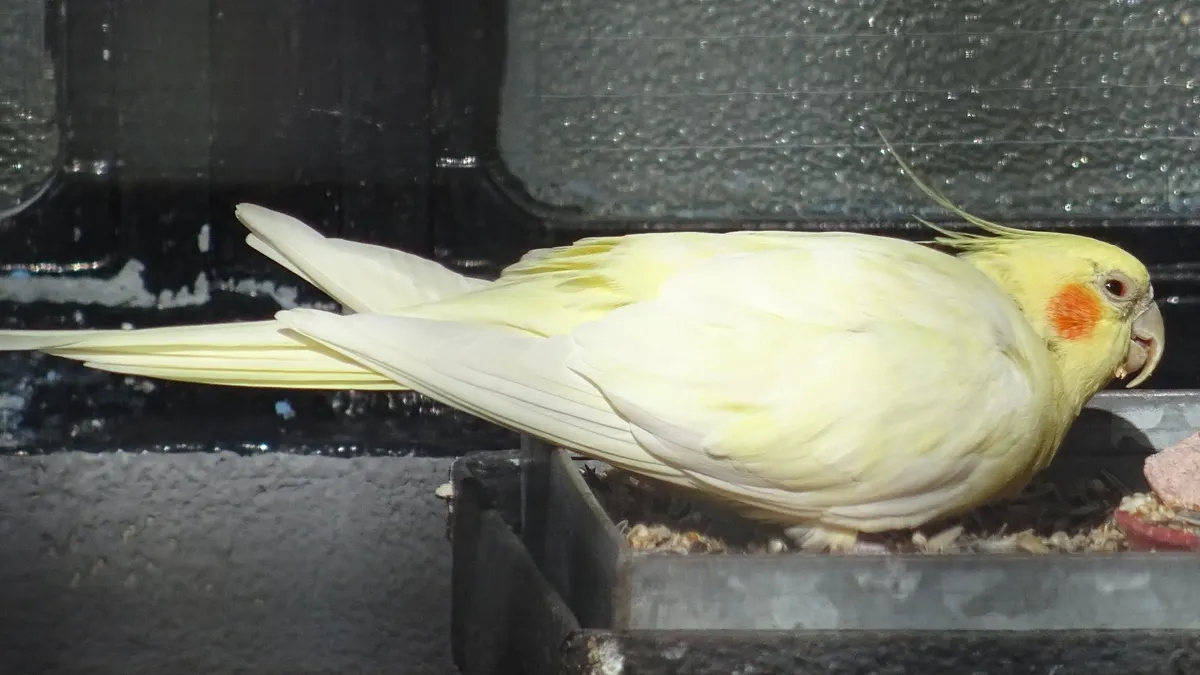
Cover photo: cacatúa ninfa, calopsitte élégante, cocatiel, cockatiel by Y. Liu, CC BY 4.0, via inaturalist. Cropped.
Related guides
What Do Cockatiels Eat? A Vet-Based Daily Diet for Cockatiels
The daily cockatiel diet from VCA and Merck: pellet, produce and seed shares, vitamin A foods, a cockatiel vitamin A study, hen calcium and toxic foods.
Best Finch and Canary Food (2026): Pellets, Seed and Egg Food Compared
Six finch and canary foods compared on the makers' own labels against VCA's and Merck's figures, with daily servings that differ by three times.
Best Lovebird Food (2026): Five Pellets and Blends Held to Vet Figures
Five lovebird foods compared on the makers' own labels against VCA's and Merck's diet figures, with the calcium levels only one maker publishes.